
Motorcycle riding in Germany
Motorcycle Riding in Germany: The Complete Guide to the Ultimate Roads
Germany is the undisputed number one region for Dutch and Belgian motorcyclists who want to trade flat polder roads for serious cornering, without having to ride for days to get there. German roads offer the perfect balance of excellent asphalt, traffic rules that are firm but not too restrictive, and a network of beautiful…
Germany is the undisputed number one region for Dutch and Belgian motorcyclists who want to trade flat polder roads for serious cornering, without having to ride for days to get there. German roads offer the perfect balance of excellent asphalt, traffic rules that are firm but not too restrictive, and a network of beautiful mountain roads. If you leave unprepared, you risk fines and road closures, so read up in advance on sound checks and dB limits for motorcycles. Tackle the trip strategically and, just across the border, you will find the ultimate playground for sharp bends and flowing sweepers.
Besides Germany, we also have free motorcycle routes available for other European countries.
Jump to
The Best Regions for Motorcyclists
Not every stretch of German asphalt is worth programming into your sat nav, but the following regions form the backbone of a fantastic motorcycle holiday, each with its own character.

The Eifel: Technical Asphalt Around the Nürburgring
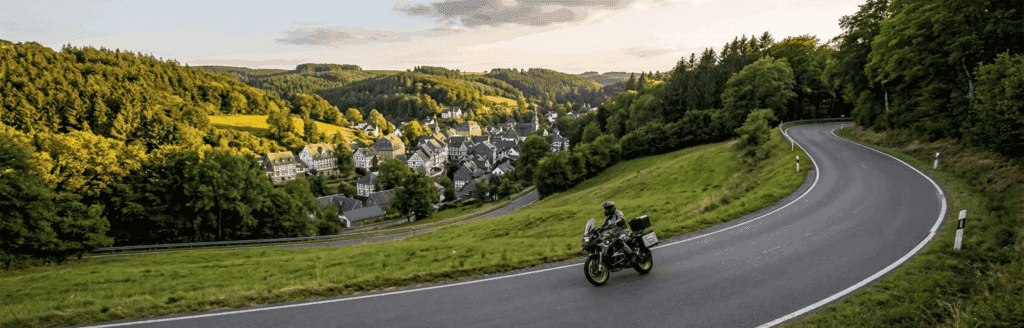
Looking for a serious riding challenge close to home? The Eifel delivers without compromise. As soon as you cross the border, straight main roads give way to tight hairpins and blind sequences of bends. The focus is around the Rursee and the unforgiving B258 near the Nürburgring, where you ride your tyres right to the edge and the asphalt leaves little room for corrections. This area demands an active riding style; you can rest later.
No need to doubt the Eifel: you will find much more in our complete guide to motorcycle riding in the Eifel.

Sauerland: Carrying Speed Through Rolling Sweepers
For motorcyclists who value smooth riding and getting into a rhythm, Sauerland is the clear winner. In this low mountain region you will find wide, well-surfaced Bundesstrassen full of clear, flowing sweepers. Explore the slopes around the Kahler Asten or guide your motorcycle at a brisk pace along the B236 towards the Diemelsee. The riding rhythm here is considerably higher than in the Eifel and the bends are more forgiving. That makes it prime territory for sport tourers and large adventure bikes.
Ready for more? Explore the best motorcycle routes in Sauerland.

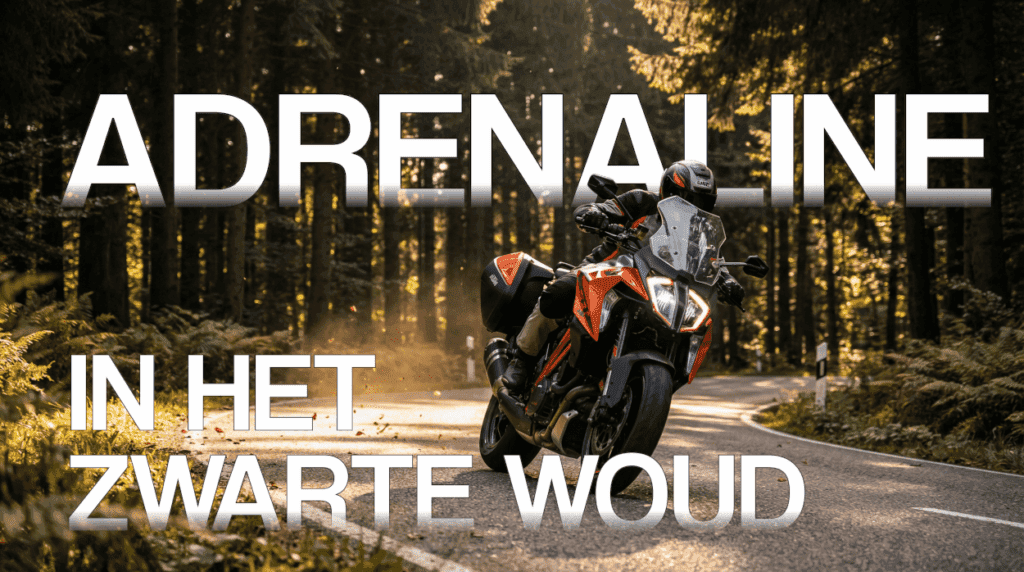
Black Forest (Schwarzwald): The Ultimate Alpine Prologue
Big in scale, extremely twisty and with serious elevation gain: the Black Forest is the perfect test run for Alpine riding. The road network here is dominated by the Schwarzwaldhochstrasse (B500), a beautifully flowing road with wide asphalt past the Mummelsee. Beyond the main roads lies a network of narrower forest roads. For serious touring riders looking for major elevation changes and excellent asphalt, this southern region is the very best Germany has to offer.
Plan your southern expedition with the ultimate guide for your motorcycle holiday in the Black Forest.
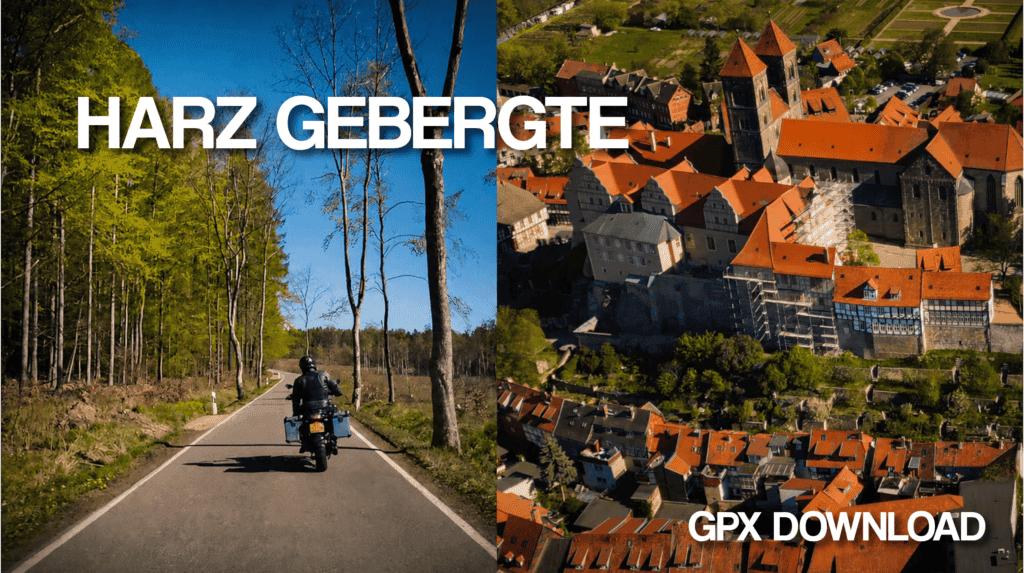
Harz Mountains: Variety, Forests and Surprisingly Good Riding
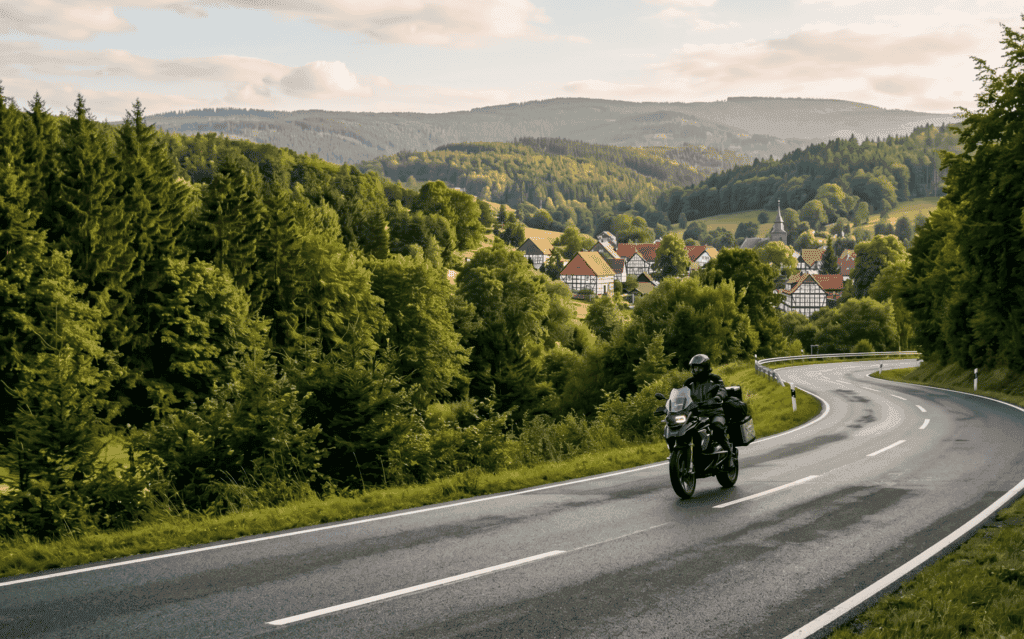
If you want something different from the familiar Eifel or Sauerland, the Harz Mountains are a strong choice. This region lies a little deeper into Germany, which also makes it feel more like a proper short motorcycle trip. Do not expect Alpine passes or endless hairpins, but do expect a varied mix of dense forests, rolling roads, reservoirs, half-timbered towns and unexpectedly enjoyable sections of twisty road.
Around Clausthal-Zellerfeld, Wernigerode, Drei Annen Hohne and Kelbra, you get exactly that typical Harz character: sometimes quiet and green, sometimes lively and touristy, with several roads where you can really settle into your rhythm.
Want to know more? Read our guide to motorcycle riding in the Harz Mountains.
Not sure which region to choose? Compare the main German motorcycle regions on the Germany motorcycle routes overview.
GPX Downloads
Filters
Actieve filters
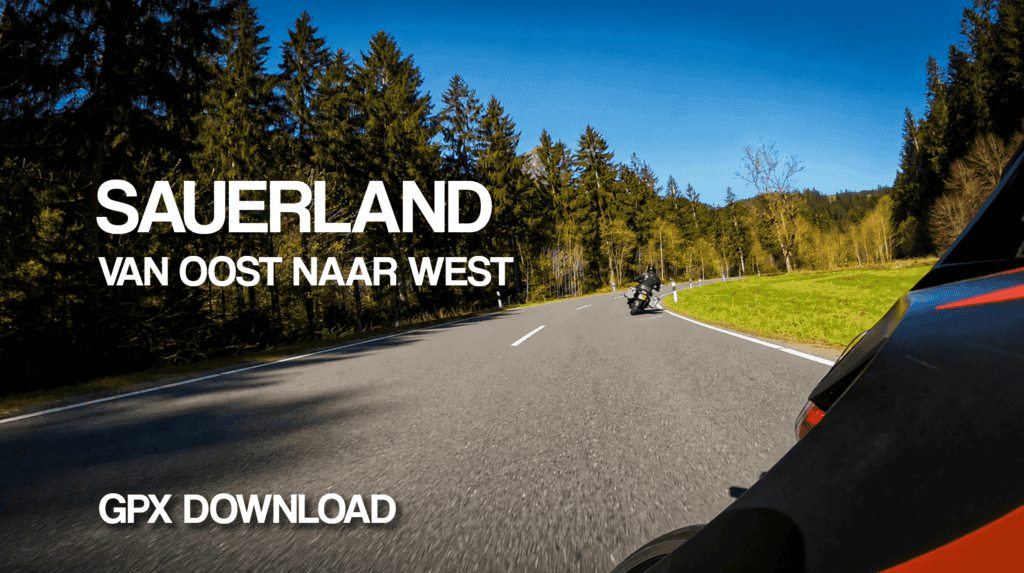
Watch the Video
More Inspiration & Information
Filters
Actieve filters
Practical Information
Below you will find some practical information for motorcycle riding in Germany.
Road Laws and Safety (Polizei)
Forget the Dutch culture of tolerance. German enforcement for motorcyclists is strict, systematic and leaves no room for leniency. Make sure you comply with the legal requirements for motorcycles in Germany before you head onto the Autobahn, to avoid immediate impoundment or sky-high fines.
- dB killers and E marks: The Polizei are uncompromising during sound checks. If your dB killer is missing or your aftermarket exhaust does not have a valid E mark, your ride is over and the bike stays put.
- Streckensperrungen: Popular, twisty road sections in the Eifel and Sauerland are completely closed to motorcycles on weekends and public holidays. Check whether there are restrictions on your route.
- The Rettungsgasse: When traffic jams form on the Autobahn, filtering through on a motorcycle is absolutely not allowed. You are legally required to move as far to the outside as possible to create a clear lane in the middle for emergency services.
German Motorcycle Culture: Bikertreffs and Logistics

Stopping in Germany calls for a different approach than in the Netherlands. Logistics in mountainous rural areas sometimes require a little planning, but the facilities for motorcyclists are generally excellent.
Motorradfreundliche hotels: Looking for somewhere to stay? Do not focus only on regular booking sites; filter for hotels with the official Motorradfreundlich label, often recognised by the ADAC. These accommodations may offer locked parking garages, equipped tool trolleys for emergency repairs and ventilated drying rooms for wet motorcycle gear.
The institution of the Bikertreff: Forget standard roadside restaurants. Germany has hundreds of dedicated Bikertreffs: large meeting places specifically for motorcyclists. They are often strategically located near reservoirs or popular mountain roads. These are the real epicentres for checking out bikes, swapping routes and grabbing the famous German Bratwurst.
Fuel stops in rural areas: The density of petrol stations in the Eifel or the Black Forest is noticeably lower. Local filling stations in villages are also often unmanned or simply closed on Sunday afternoons. The hard rule: if you pass a petrol station in a rural area and your tank is half empty, fill it up. The main fuels here are Super (E5) and Super E10.
Frequently Asked Questions About Motorcycle Riding in Germany
Do you need a toll vignette or emissions sticker for a motorcycle in Germany?
No. Motorcycles are fully exempt from road tax and Autobahn tolls in Germany. You also do not need an emissions sticker (Umweltplakette) to ride your motorcycle into German city centres.
Are you allowed to filter through traffic on a motorcycle in Germany?
No, filtering through traffic jams is officially prohibited and can result in a fine. When traffic starts to build up, you must immediately position yourself far to the right or left to keep the centre lane (Rettungsgasse) clear for approaching emergency services.
Are dB killers mandatory in Germany?
Yes, without exception. German enforcement on exhaust noise is extremely strict. Riding without an approved dB killer or valid E mark will inevitably lead to a substantial fine and the motorcycle being stopped on the spot.
Germany has everything you need for a great motorcycle trip, but make sure you set off well prepared. From rules to practical choices on the road: know what you are getting into. → Head out prepared with our Motorcycle Trip Preparation guide.
Your next ride
Continue planning your motorcycle trip
Explore more routes and practical information for a well-prepared ride.
MotorMakkers Start
Your first motorcycle holiday: how to get started well prepared
Planning your first weekend or multi-day motorcycle trip abroad? Here we guide you step by step: from choosing a suitable destination and GPX route to luggage, navigation, accommodation and the final checks before departure.
A motorcycle holiday does not have to be complicated
Your first multi-day motorcycle trip can feel like a bigger undertaking than it really is. How many kilometres should you plan? Which roads are suitable? How does a GPX work? What should you pack and where should you stay? The most important thing is not organising everything perfectly, but making the right choices in the right order.
That is why you will not find an endless checklist here of things you supposedly have to do. MotorMakkers Start helps you keep your first trip manageable: a realistic destination, a good route, solid preparation and enough room to simply enjoy the ride.
Your first motorcycle holiday in 6 steps
Do not start by buying gear. Start with the trip you want to make. Once that is clear, it becomes much easier to see what you actually need.
1
Choose a realistic destination
You do not have to head straight for the Stelvio on your first trip. A region such as the Eifel, Luxembourg or the Sauerland already gives you that real feeling of riding abroad without making the trip unnecessarily demanding.
View beginner destinations2
Choose a route that suits you
Kilometres only tell part of the story. Also look at bends, technical sections, elevation changes, traffic and how much energy the route is likely to require.
View our motorcycle routes3
Make sure your GPX works
Understand the difference between a route and a track, and test before departure whether your Garmin, TomTom or navigation app handles the file the way you expect.
GPX for beginners4
Plan realistic riding days
A twisty 200-kilometre day can be more tiring than hundreds of motorway kilometres. Leave enough margin for coffee, fuel, lunch and an unexpected stop.
Prepare your motorcycle trip5
Pack smart
Do not take everything that might possibly be useful. Start with what you really need for riding, bad weather, documents, breakdowns and overnight stays.
Create your personal packing list6
Check everything shortly before departure
Check the motorcycle, the weather and your route. A GPX created months ago may now run into a road closure, restriction or closed mountain pass.
Check your GPXWhere should you go on your first motorcycle holiday?
The best first destination is not automatically the most spectacular one. Choose an area that is easy to reach, has plenty of good roads and lets you adjust the difficulty without much effort.
Recommended for beginners
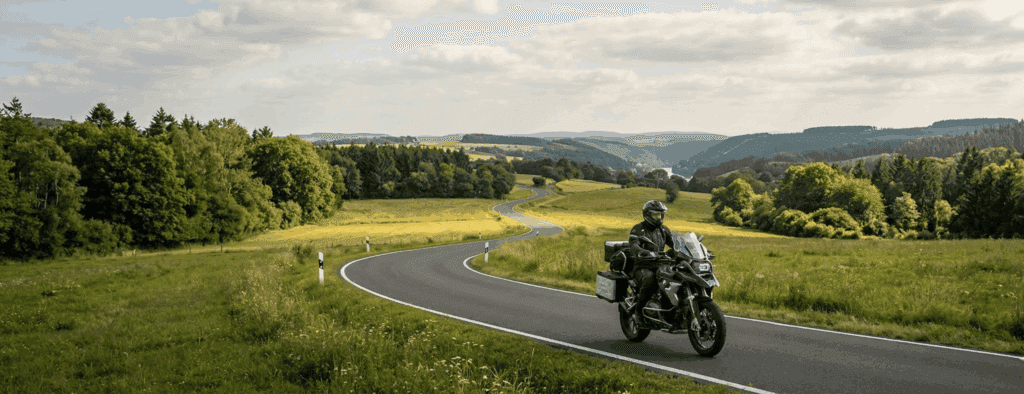
Eifel
Close to the Netherlands, with plenty of good roads and enough variety without having to tackle extremely technical mountain roads straight away. For many riders, this is the most logical first step across the border.
- Ideal for 2–3 days
- Plenty of flowing bends
- Wide choice of hotels
- Easy to reach from the Netherlands

Compact & manageable
Luxembourg
Compact, varied and well suited to a first short trip abroad. Routes are easy to shorten, but make sure you know the local traffic rules and have the required documents and equipment with you.
- Short distances
- Plenty of scenic back roads
- Routes are easy to shorten
- Be aware of local rules and checks
Next step
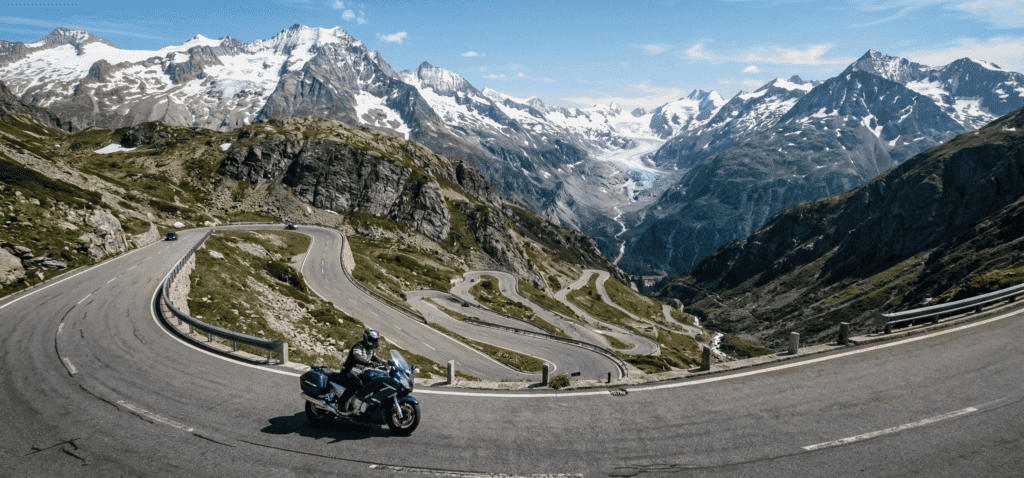
The Alps
Ready for real mountain passes? Do not automatically start with the most famous or most difficult pass. Choose an accessible first pass and gradually build up the technical difficulty.
- More elevation change
- More hairpin bends
- Weather has a bigger impact
- More preparation required
MotorMakkers Rookie Route
Not every great route is a good first route
With our Rookie Routes, we select routes that are enjoyable enough to feel like a proper motorcycle trip, but manageable enough for less experienced touring riders to enjoy at a relaxed pace.
We do not just look at distance, but also at technical sections, hairpins, road type, busy towns, rest stops and the practical feasibility of the entire day.
What we look for in a Rookie Route
Day distanceManageable
Technical difficultyLow / medium
BendsPlenty
Extremely narrow roadsLimited
Rest & fuel optionsGood
GPXTested
GPX and navigation: understand what you are loading
Downloading a GPX file is easy. Making sure your navigation system does exactly what you expect on the road takes a little more attention.
GPX for beginners: how it works
Learn the difference between routes, tracks and waypoints, and discover why the same GPX can behave differently on different navigation systems.
GPX for beginners: how it worksWhat will your route feel like to ride?
MM FlowIndex gives you a better idea in advance of the bends, flow, elevation and technical characteristics of a GPX route.
Analyse with FlowIndexAre there restrictions on your route?
Check whether your GPX runs into known road closures, motorcycle restrictions, dB limits or closed mountain passes.
Open Route CheckerPlanning an Alpine ride?
Compare mountain passes by elevation, hairpins, gradient, riding character and current status before adding them to your trip.
Compare Alpine passesPrepare for your trip without packing half your house

Good preparation is not about taking as much as possible. It is about having the most important things sorted so you do not have to improvise unnecessarily while travelling.
Motorcycle and maintenance
Check tyres, tyre pressure, chain, brakes, lights, fluids and whether scheduled maintenance is likely to fall right in the middle of your trip.
Luggage
Pack heavy items low and centrally. Keep rain gear, documents and items you use on the road easy to reach.
Documents & breakdowns
Make sure insurance details, breakdown cover, driving licence, vehicle documents and important phone numbers are also available offline.
Accommodation
For your first multi-day trip, booking ahead often makes things more relaxed. Also look for secure motorcycle parking and consider how well the accommodation is positioned for your planned routes.
The final check
Ready to go?
Run through these points once more in the final days before departure. Then, on the morning itself, all that is left to do is start the bike.
GPX downloaded and tested
Navigation and offline maps work
Route checked for restrictions
Weather forecast checked
Accommodation arranged
Motorcycle mechanically checked
Tyres and tyre pressure are good
Insurance and breakdown cover understood
Documents packed
Packing list completed
First motorcycle holiday?
Going on your first motorcycle holiday? Start here
From day distances and route planning to luggage, documents, motorcycle checks and accommodation. In our complete preparation guide, we take you step by step through what you should arrange before departure.
Day distances
Route planning
Luggage
Motorcycle check
Accommodation
Go to the complete preparation guide
Frequently asked questions
First motorcycle holiday: practical questions
How many kilometres should I plan for my first motorcycle holiday?
That depends heavily on the type of roads. For a day with lots of smaller roads, around 150 to 250 kilometres is a comfortable range for many riders. Leave some margin rather than trying to hit a strict kilometre target every day.
What is a good destination for my first motorcycle weekend?
The Eifel and Luxembourg are strong choices because they are relatively close, offer plenty of good roads and make it easy to adapt the route to your own pace and experience.
Should I book my hotels in advance?
For a first trip, that can provide a lot of peace of mind. You know where your day will end and do not have to search for suitable accommodation after a long ride.
Are the Alps suitable for a first motorcycle holiday?
They certainly can be, but choose your routes carefully. Not every Alpine pass is equally accessible. Start with manageable roads, keep your riding days shorter and do not underestimate elevation, weather and fatigue. View the Alps for beginners.
How do I know whether a GPX route is too difficult?
Look beyond distance alone. The number of bends, hairpins, elevation changes, road type and technical sections tell you much more about how demanding a route is likely to be. The MM FlowIndex can help you assess this.
Now you only need to choose where to go
Start small, choose a route that suits you and make sure the practical basics are sorted. You will learn the rest along the way. And chances are that after your first weekend, you will already be planning the next one.