
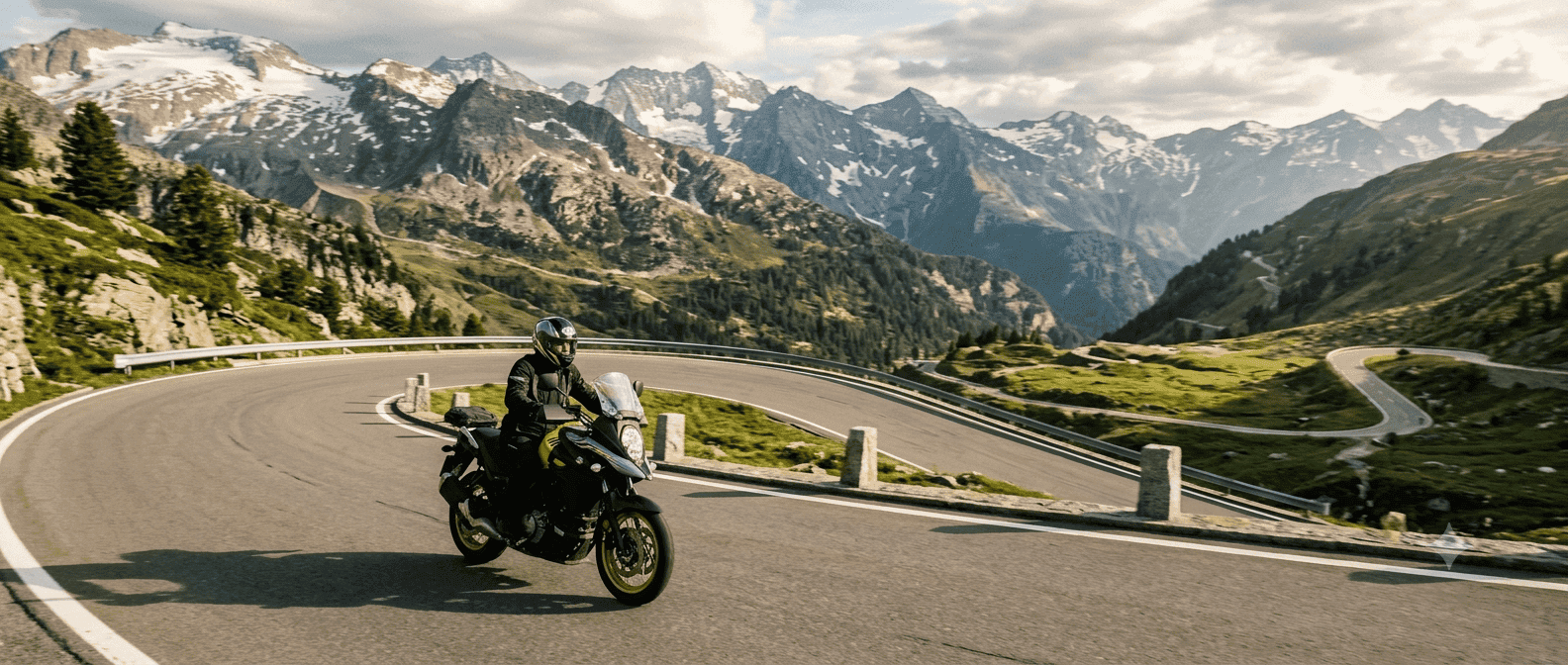
Your first real Alpine pass by motorcycle is something you will probably never forget. At home, the roads are generally flat and easy to read, but riding changes completely in the mountains. The bends become tighter, the views increasingly impressive and, at the same time, there is less room for error. Riding a mountain pass therefore feels very different from an average motorcycle ride in the Netherlands or Belgium.
The best Alpine pass for your first mountain ride is not automatically the most famous one you have seen on forums or in videos. It is far more important to choose a road that matches your riding experience, gives you enough confidence to get used to mountain riding at your own pace and still allows you to enjoy the ride.
Why famous Alpine passes are not always suitable for beginners
Names such as the Stelvio, Gavia and Furka Pass immediately capture the imagination. You have probably seen spectacular photos, stories or videos of them. However, a famous pass is not necessarily a good place to start. Some, including the Stelvio, are best avoided by most riders on their very first mountain-pass ride.
Many iconic Alpine passes are busy, have extremely tight hairpin bends and include narrow or poorly visible sections. Guardrails are absent in places, while campervans, coaches and other oncoming vehicles may unexpectedly take up a large part of the road.
When planning your first mountain ride, pay particular attention to:
- The width of the road and the quality of the surface
- Visibility through hairpin bends
- The maximum gradients and overall elevation profile
- The expected amount of traffic
- The likely presence of campervans and coaches
- Whether the pass fits comfortably into your full day route
Tip: use the Alpine Passes Database to find a pass that genuinely matches your experience. For a first mountain ride, that is usually a better approach than planning purely around your bucket list.
Which Alpine pass is suitable for your first mountain ride?
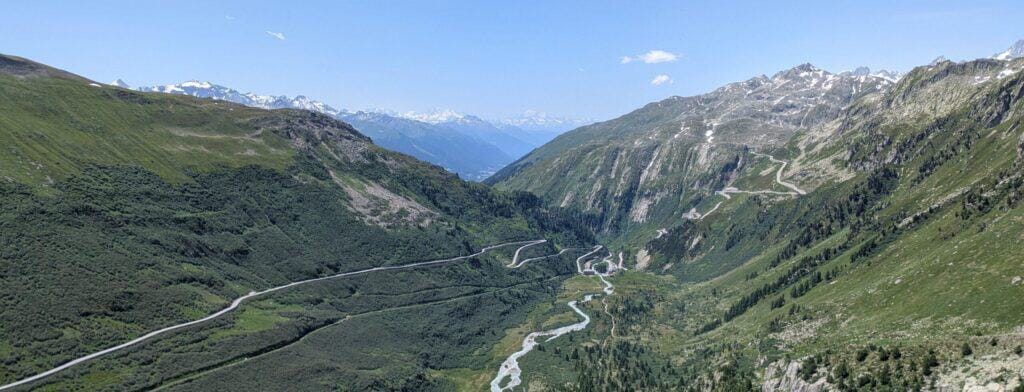
For a relaxed first introduction to the Alps, choose a pass with wide, well-surfaced roads, good visibility and a regular, flowing layout.
Good passes to consider for your first ride include:
Grimsel Pass – Switzerland
The Grimsel Pass has wide, well-maintained tarmac. Most of its hairpin bends are easy to read, and the road has an enjoyable, flowing rhythm.
Susten Pass – Switzerland
The Susten Pass is slightly more technical, but the road is spacious and the surface is generally excellent. In many places, you have a clear view of the road ahead and any oncoming traffic.
Old Brenner Road – Austria and Italy
The old Brenner road has wide lanes and relatively gentle gradients. This allows you to get used to climbing, descending and riding at altitude without immediately facing an extremely technical route.
Nockalm Road – Austria
This panoramic road mainly consists of open, flowing bend combinations. Its layout is friendly and predictable, giving you plenty of time to adapt to both the surroundings and the riding technique.
Three important tips for your first mountain ride
1. Create calm, maintain visibility and leave enough margin
On your first pass, keeping a clear and calm mind matters more than riding quickly. Set off early, keep the approach route manageable and leave plenty of time for breaks, photos and unexpected delays.
A mountain pass requires more concentration than an ordinary ride. You need to look further ahead, change gear more often and constantly account for elevation changes, oncoming traffic and changing conditions.
It is better to plan a shorter day route with one or two enjoyable passes than a long ride that only looks impressive on paper. The number of kilometres says very little about how much you actually enjoyed the day.
2. Prepare for hairpin bends and oncoming traffic
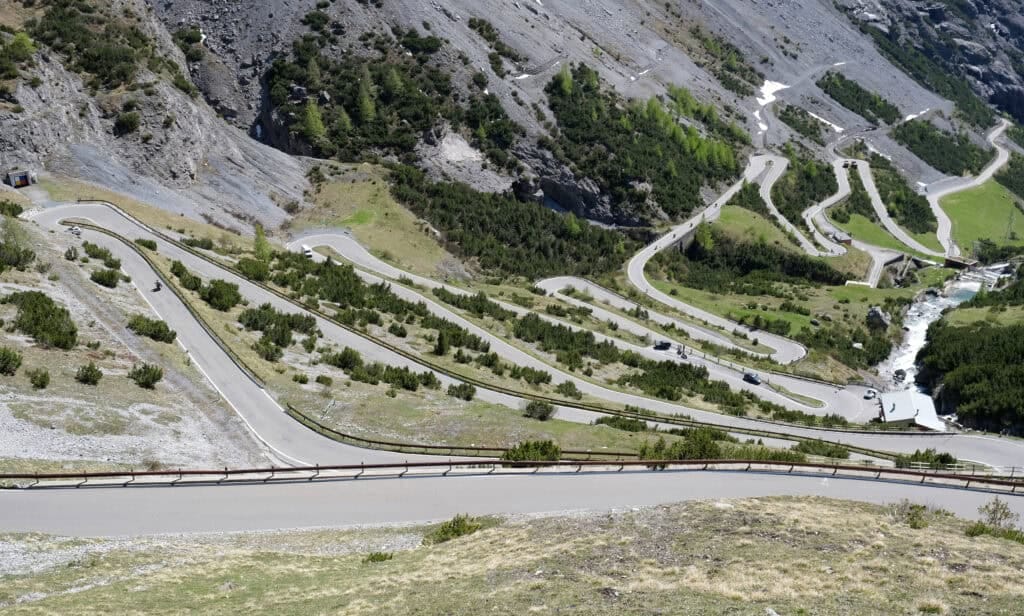
Hairpin bends can look intimidating at first. With a calm approach and good basic technique, however, they can become one of the most enjoyable parts of riding in the mountains.
Look well through the bend
Direct your eyes towards where you want to go. Do not fixate on the drop, the guardrail or the outside edge of the road.
Select the right gear in advance
Change down before turning in. Then try to ride through the bend with light, steady throttle. Faster hairpins can often be taken in second gear, while tighter bends may require first gear. Some hairpins, such as those on the Stelvio, may even require careful clutch control at very low speed.
Allow for oncoming traffic
Campervans and coaches often need more space in tight bends than you might expect. Cyclists, walkers and slow-moving traffic can also suddenly appear on or close to your line.
Keep sufficient distance
If the rider ahead suddenly has to stop or takes a bend more slowly than expected, you may also be forced to enter the bend at a different speed than planned.
Do not ride too close to the person in front. Leave yourself enough room to observe, anticipate and adjust your speed smoothly.
Want to expand your route? Also read our guide to the most beautiful Alpine passes in Switzerland.
3. Never underestimate mountain weather
The weather in the Alps can change quickly. It may be sunny and 22 degrees Celsius in the valley, while the top of the pass is covered in fog and rain with temperatures only a few degrees above freezing.
Before setting off, do not only check whether the pass is open. Also look at the temperature, precipitation, wind and visibility at the summit. Consider whether the conditions will be comfortable for you and the other riders in your group, and make sure your clothing is suitable. A flexible layering system for motorcycle clothing is strongly recommended.
Skipping a pass because of bad weather or fatigue is not a failure. It is a sensible decision. The mountains will still be there next time.
Which Alpine passes are suitable for your first ride?
Not every famous mountain pass is automatically a good choice for your first motorcycle ride in the Alps. The recommendations below are intended for riders who already have sufficient general riding experience but have not previously ridden on true high-Alpine mountain roads.
Good passes for your first ride
Open, predictable and suitable for building confidence.
-
Nockalm Road
– Austria
A well-maintained panoramic road with flowing bends, good tarmac and plenty of places to stop. It is an enjoyable route for gradually getting used to climbing, descending and longer bend combinations.
Predictable and forgiving -
Grimsel Pass
– Switzerland
Predominantly wide tarmac, easy-to-read hairpins and an enjoyable rhythm. You experience genuine high-Alpine scenery without the road being continuously narrow or difficult to read.
Spacious and impressive -
Susten Pass
– Switzerland
Slightly more technical than the Grimsel Pass, but spacious and generally easy to read. Its flowing bends make it a good next step for a rider who is already feeling confident in the mountains.
Flowing but slightly technical -
Col du Petit-Saint-Bernard
– France / Italy
A relatively gradual pass with many wide bends and few extremely steep sections. This lets you get used to elevation changes and riding above the tree line at a relaxed pace.
Gradual and accessible -
Old Brenner Road
– Austria / Italy
Less spectacular than the other passes, but technically accessible. A good choice when your main goal is to become comfortable with longer descents, elevation changes and mountain traffic.
A gentle first introduction
Better saved for later
Narrow, intense or technically demanding for a first mountain ride.
-
Gavia Pass
– Italy
Long sections are extremely narrow and offer little room when meeting oncoming traffic. Steep drops, limited visibility and few places to move aside require calmness and good motorcycle control.
Narrow and intimidating -
Stelvio Pass – eastern side
– Italy
Dozens of short hairpin bends follow one another in quick succession. Combined with campervans, cyclists, cars and other motorcycles, this side can quickly become intense and tiring.
Tight, busy and intense -
Splügen Pass – Italian side
– Italy / Switzerland
Narrow hairpins, dark tunnels and covered galleries follow one another rapidly. Oncoming traffic and damp sections can add extra pressure.
Tight and difficult to read -
Mortirolo Pass
– Italy
A steep and, in places, extremely narrow pass. Stopping, pulling away or manoeuvring slowly in a sloping hairpin can be difficult, especially on a heavy or fully loaded motorcycle.
Steep and technical -
Col de Turini
– France
Long sequences of short bends and hairpins offer few opportunities to relax. It is not exceptionally dangerous, but it can quickly become tiring for a rider with little mountain experience.
Twisty and intense
Conclusion: choose control and riding enjoyment
A good first Alpine pass builds confidence. At the end of the day, you should get off the motorcycle with a broad smile and the feeling that you have learned something new.
Do not immediately choose the most difficult or famous pass. Look for a route that offers calm conditions, good visibility and enough room to become comfortable. The more challenging passes can follow later.
Enjoy it. Riding mountain passes is one of the most rewarding parts of motorcycling.