
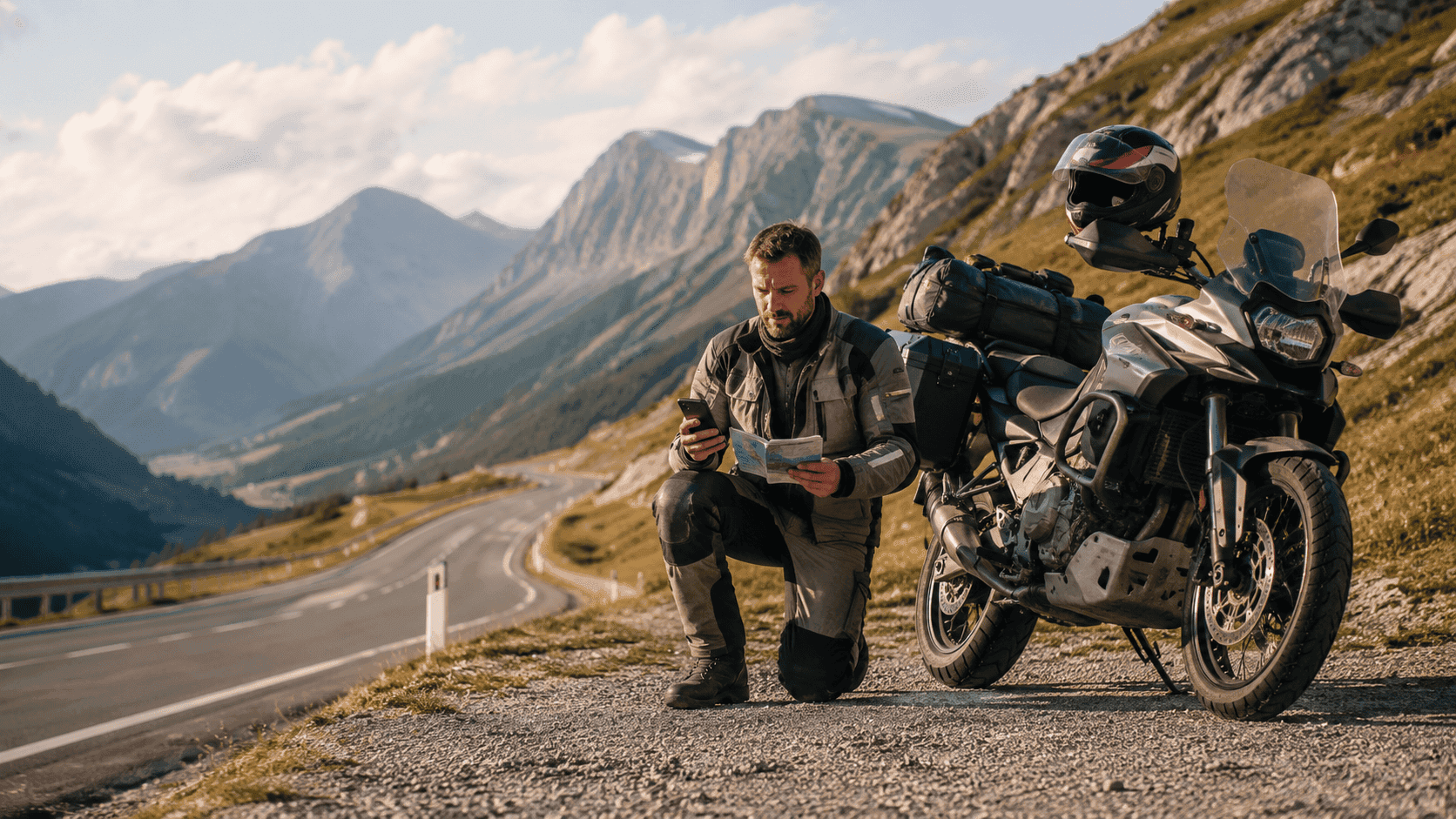
Breaking down on a motorcycle is never fun. When it happens somewhere abroad, it usually brings an extra dose of stress. Who should you call? Where exactly are you? And will the recovery costs actually be covered?
Those are not questions you want to start answering while your motorcycle refuses to start and traffic is rushing past you. Fifteen minutes of preparation at home can save you a great deal of hassle on the road.
Before you leave, check your breakdown cover, save important information offline and make sure you know how to share your exact location quickly.
What should you do if your motorcycle breaks down abroad?
Have you actually broken down at the side of the road? First make sure that both you and your motorcycle are in the safest possible position. Switch on your hazard lights if your motorcycle has them and, especially on a busy road, stay well away from passing traffic.
Only call 112 in the event of an accident, injury or immediate danger. For an ordinary mechanical breakdown, contact your insurer’s emergency assistance centre or roadside assistance provider. You will find a list of commonly used numbers further down this page.
Keep the following information close at hand:
- Your exact location, such as GPS coordinates or a road number;
- Your motorcycle’s registration number;
- Your insurance policy or membership number;
- A brief description of the problem;
- A telephone number on which you can be reached.
The good news is that you can collect almost all of this information before you leave home.
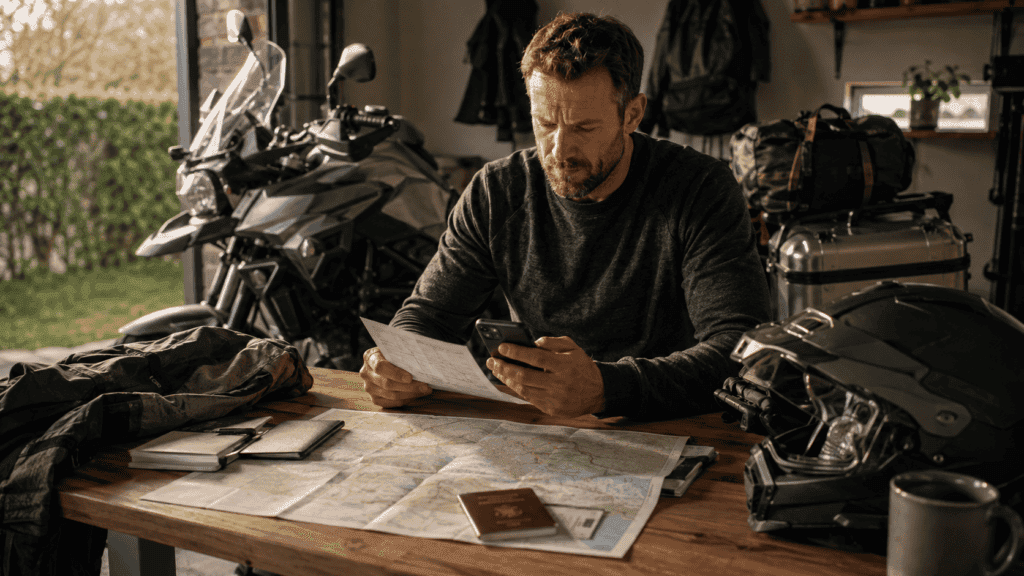
Check your breakdown cover before departure
Do not automatically assume that your existing roadside assistance also covers your motorcycle abroad. Check in advance which countries are included and whether motorcycles are explicitly covered.
Pay particular attention to:
- Cover for motorcycles;
- Any age limits that apply to your motorcycle;
- The conditions for repatriating your motorcycle;
- Replacement transport;
- Assistance with a puncture or starting problem;
- Maximum reimbursements for repairs and recovery.
The conditions for motorcycles may differ from those for cars. Some insurers arrange a recovery vehicle immediately, while others expect you to pay certain costs yourself first and claim them back later.
Also check what happens if your motorcycle cannot be repaired quickly. Will it be transported back to your home country? Are you entitled to replacement transport? And are you allowed to continue your journey in another way?
It may not be the most exciting part of preparing for a motorcycle trip, but it does not take long. It is much better to sort it out a few weeks before departure than to rush through pages of policy conditions the evening before you leave.
Save emergency numbers and important details offline
Save the emergency assistance number in your phone. Make it clear in the contact name which insurer or roadside assistance provider the number belongs to. That way, you will not have to guess which number you need when you are standing at the side of the road.
Do not rely entirely on your smartphone. A flat battery, a broken screen or no mobile signal usually happens at exactly the wrong moment.
Keep the most important information available offline as well. This should include:
- The telephone number of the emergency assistance centre;
- Your insurance policy or membership number;
- Your motorcycle’s registration number;
- Your insurer’s contact details;
- An emergency contact;
- Important medical information.
You can write this information on a small card and keep it with your travel documents. A screenshot on your phone is useful too, as long as you can open it without an internet connection.
Travelling with a group of motorcycle mates? Share the most important information with each other beforehand. While you stay with the motorcycle or make the location safe, one of your travelling companions can contact the assistance centre.
Below you will find commonly used roadside assistance numbers for several European countries.
Roadside assistance numbers in Europe
| Country | Roadside assistance provider | Telephone number | Additional information |
|---|---|---|---|
| 🇳🇱 Netherlands | ANWB Wegenwacht | 088 269 28 88 | For roadside assistance within the Netherlands. |
| 🇧🇪 Belgium | Touring | 078 178 178 | In a dangerous situation on the motorway, call 112 first. |
| 🇱🇺 Luxembourg | ACL | +352 26000 | Available 24/7 for breakdowns or accidents, including motorcycles. |
| 🇩🇪 Germany | ADAC | +49 89 20 20 40 00 | Internationally accessible telephone number. |
| 🇫🇷 France | Your own assistance provider | No general national roadside assistance number | On a motorway, use an orange emergency telephone or the SOS Autoroute app. |
| 🇨🇭 Switzerland | TCS | 0800 140 140 | Roadside assistance from the Touring Club Switzerland. |
| 🇳🇴 Norway | NAF Veihjelp |
08505 +47 926 08 505 |
Use the +47 number when calling from a foreign mobile network. |
| 🇦🇹 Austria | ÖAMTC |
120 +43 1 25 120 00 |
The second number is suitable when calling from abroad. |
| 🇮🇹 Italy | ACI Soccorso Stradale |
803 116 +39 02 66 165 116 |
Use the +39 number when calling from a foreign phone. |
| 🇪🇸 Spain | RACE |
900 112 222 +34 91 594 89 43 |
Use the +34 number when calling from abroad. |
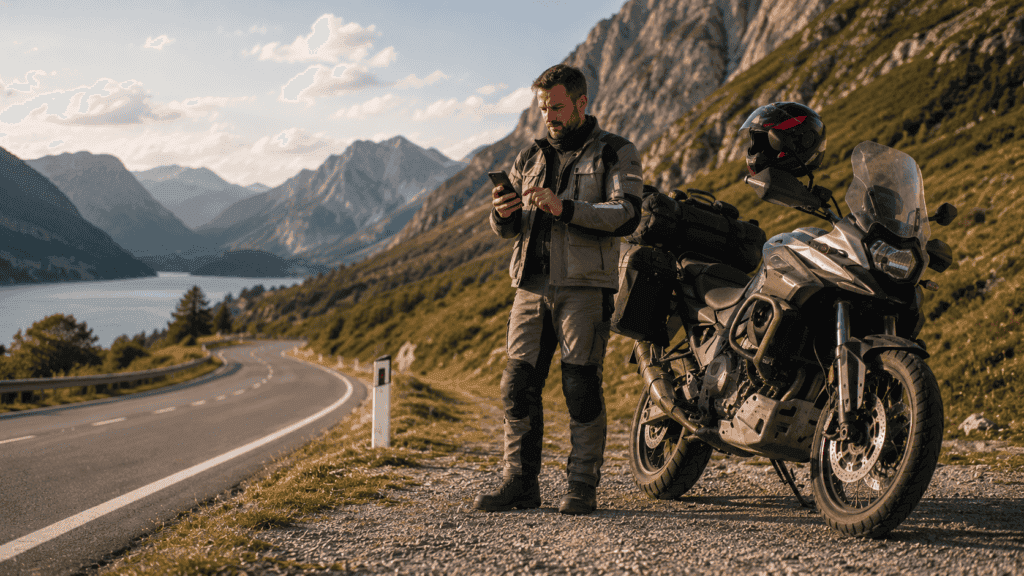
Make sure you know where you are
One of the first questions the assistance centre will usually ask is: where exactly are you?
On a motorway, you may be able to give them a kilometre marker or roadside reference. On a small mountain road, in the middle of a forest or somewhere between two remote villages, that can be much more difficult.
Make sure you know how to find and share GPS coordinates on your phone or navigation device. Also look for recognisable points nearby, such as:
- The road number;
- The nearest town or village;
- The name of a mountain pass;
- A kilometre marker or roadside reference post;
- The last exit or junction you passed;
- A nearby petrol station, restaurant or hotel.
Consider taking a screenshot of your location on the map as soon as you stop. This can be useful if your mobile connection drops or you need to provide the location again later.
For a recovery service, the most important thing is being able to find you. A detailed technical diagnosis is usually unnecessary. “The motorcycle will not start” or “the rear tyre is flat” is often enough to send the right type of assistance.
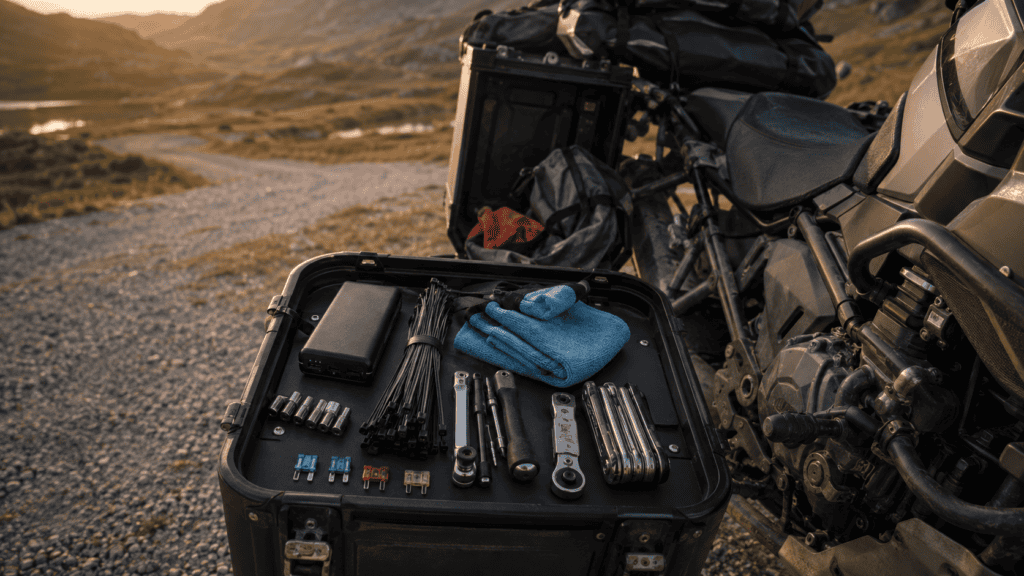
Take a compact emergency kit
You do not need to be a trained mechanic to go on a motorcycle holiday. Even so, a few simple items can be surprisingly useful on the road.
Consider taking:
- A few strong cable ties;
- Good-quality duct tape;
- A microfibre cloth;
- A fully charged power bank;
- The standard tool kit supplied with your motorcycle;
- A small torch or head torch;
- Suitable spare fuses.
Cable ties or duct tape can sometimes be used to secure a loose cable, vibrating fairing panel or partly detached number plate. They are not intended to keep you riding for hundreds of miles, but they may help you reach a workshop, car park or hotel safely.
Also take a look at our general motorcycle holiday packing list. It will help you avoid carrying unnecessary duplicate tools while still bringing the items you are most likely to need.
If you cannot repair something safely, do not attempt it. Your own safety should always come first, especially beside a busy road. Leave the motorcycle in the safest possible position and wait behind the crash barrier or well away from the carriageway.
Checklist before departure
Before every motorcycle trip abroad, quickly check the following:
- Is my breakdown cover valid in every country on my route?
- Are motorcycles explicitly included in the cover?
- Do I know when my motorcycle will be transported back to my home country?
- Am I entitled to replacement transport?
- Is the emergency assistance number saved in my phone?
- Have I also saved my policy number and registration details offline?
- Do I know how to find and share my GPS coordinates?
- Are my phone and power bank sufficiently charged?
- Do my travelling companions have my emergency details?
A little preparation brings a lot of peace of mind
Arranging your roadside assistance before departure takes very little time and does not add a single gram to your luggage. What it does give you is peace of mind.
You know who to call, which information you need and what you can expect from your insurer or roadside assistance provider. Hopefully, you will never need any of it. But if you do break down, you will not have to work everything out from scratch at the side of the road.
Once that practical side is sorted, you can focus again on what the trip is really about: enjoying the ride.
Frequently asked questions about motorcycle breakdowns abroad
For an ordinary motorcycle breakdown, contact your insurer’s emergency assistance centre or your roadside assistance provider. Only call 112 in the event of an accident, injury or immediate danger to you or other road users.
No. This depends on your policy conditions and the expected repair time. The assistance provider will usually first check whether the motorcycle can be repaired locally. Check in advance under which conditions your motorcycle will be repatriated.
The assistance centre will usually ask for your exact location, motorcycle registration number, insurance policy or membership number, telephone number and a brief description of the problem.
First make sure you are standing somewhere safe. Moving to a higher or more open location may help, but only leave your motorcycle unattended when it is safe to do so. If you are travelling in a group, one of your companions may be able to look for a signal. Keep important emergency numbers and details on paper as a backup.