
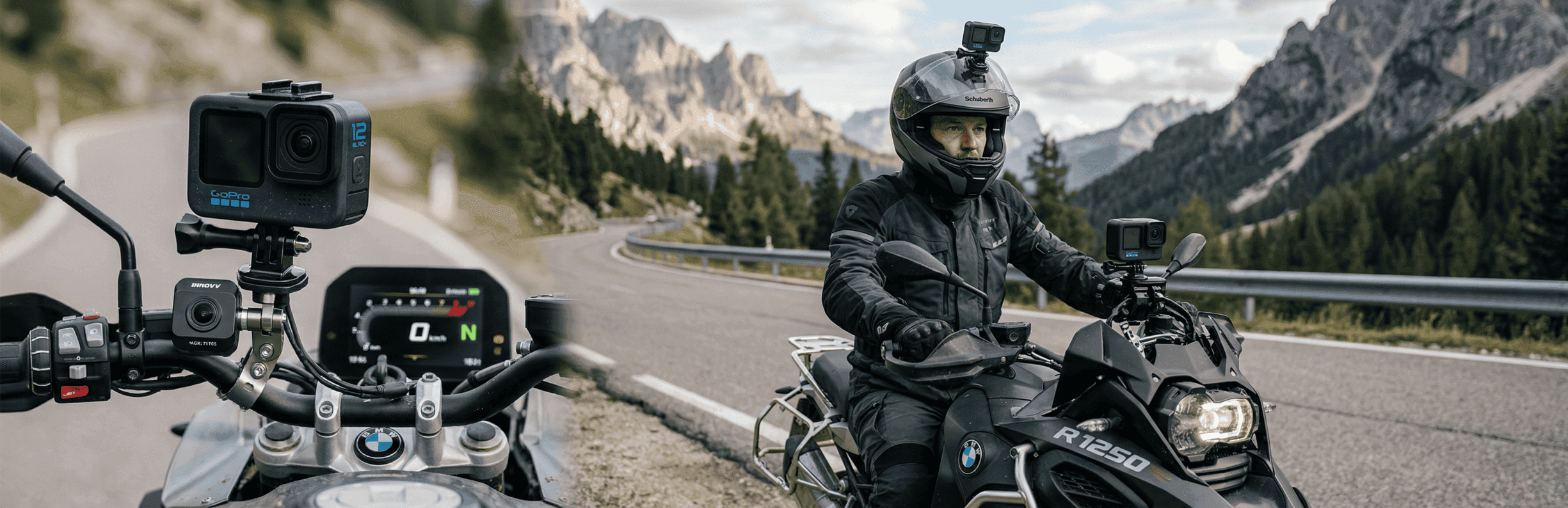
More and more motorcyclists ride with a camera. Sometimes it is a GoPro on the helmet, sometimes an action camera on the chest, and sometimes simply a fixed dashcam on the handlebars or fairing. That makes sense. It is fun to watch back a great ride, especially if you have ridden through the Alps, Ardennes or Black Forest. And it also feels reassuring to have footage if something happens along the way.
At the same time, there is a tricky side to this. As soon as you cross a border with a camera on your motorcycle, you enter a maze of rules. What feels completely normal in the Netherlands can suddenly cause hassle in another country. Sometimes it is about privacy, sometimes about how you film, and sometimes mainly about what you do with the footage afterwards.
And that is exactly the difficult part: it is not only about whether you are allowed to film. It is also about where the camera is mounted, whether it records continuously, and whether you later publish the footage online or use it as evidence.
It Basically Comes Down to Three Things
If you want to understand what is sensible or allowed, it helps to look at motorcycle camera use in three parts.
First: where is the camera mounted? On your helmet, on the handlebars, on the fairing or somewhere else?
Then there is the second question: does it actually record while you are riding? Are you continuously filming everything around you, or only short clips?
And only then comes the third layer: what do you do with the footage? Do you keep it only for yourself, use it after a collision, or post it on YouTube, Instagram or Facebook?
That last part is often forgotten. Many people think: filming is allowed or filming is not allowed. But in practice, the sensitivity often lies in storing, sharing and publishing the footage.
Camera on Your Helmet: Technically Possible, Legally More Sensitive
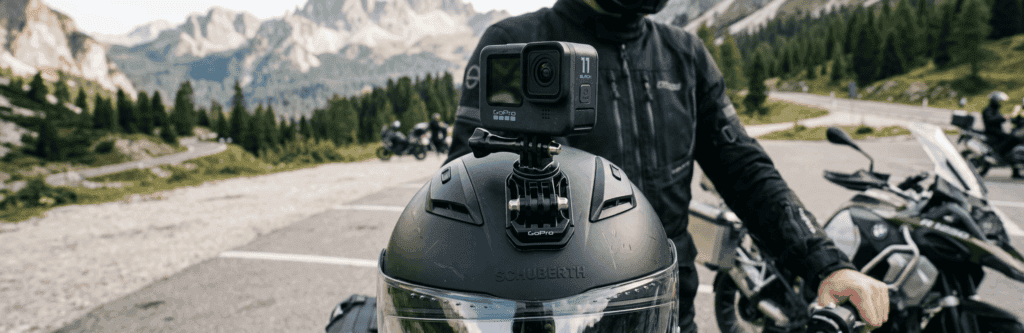
You see helmet-mounted cameras everywhere. Among motorcyclists, they have become almost normal. Still, there is a small catch.
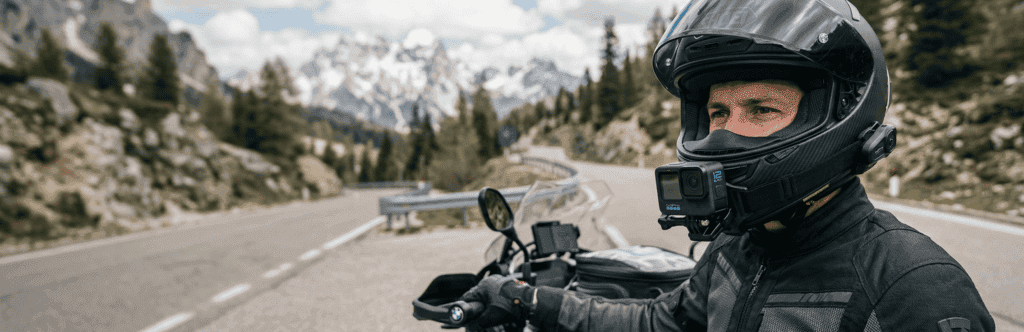
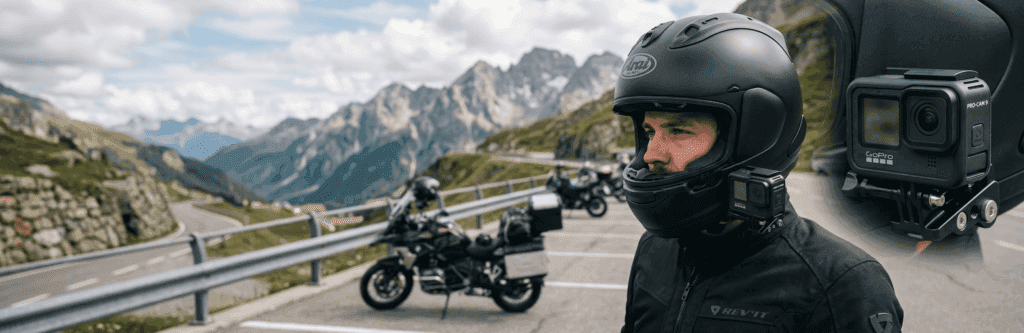
With the arrival of the ECE 22.06 standard, more attention has been paid to anything attached to a helmet. Put simply: if you stick or screw something onto your helmet that was not included by the manufacturer in the approval, you officially enter a grey area. Your helmet is then no longer completely “as approved”.
In practice, not every police officer will immediately make an issue of this. To be honest, that does not happen everywhere by any means. But the real risk may lie somewhere else: with an insurer after an accident.
They could argue that a mounted camera affected the injury. For example, because extra mass or a protruding mount made the impact worse. Whether that would always hold up legally is another matter, but it is a discussion you would rather avoid when you are already dealing with damage or injury.
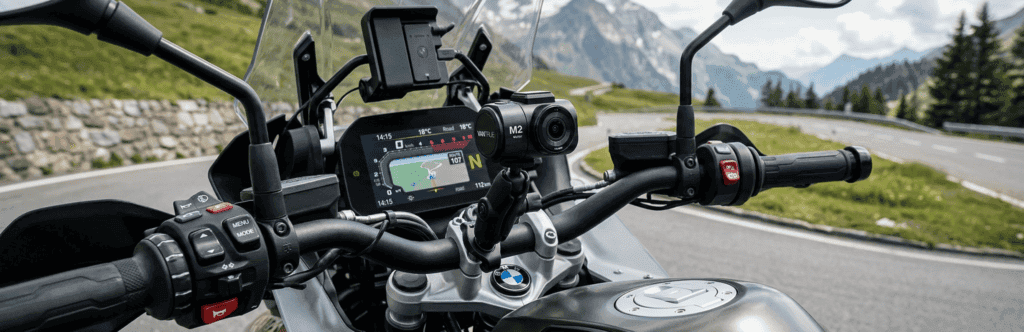
That is why the safest advice is still fairly simple: if you want to avoid hassle, mount your camera on the motorcycle itself instead. For example on the handlebars, fairing or crash bar. That is usually a little less sensitive than a camera on the helmet.
The Netherlands and Belgium: Usually Little Hassle, but Not Completely Without Rules
In the Netherlands, using a dashcam or action camera on a motorcycle is quite normal in practice. You may film, including while riding, and usually nobody makes a problem of it. It becomes more sensitive when you publish footage of other road users online. Then privacy comes into play, and it is smart to make number plates and faces unrecognisable.
Belgium is fairly similar, although when footage is used as evidence after an accident, there is often more attention to how and when you use it. The idea that you need to handle it properly and transparently plays a stronger role there.
For many motorcyclists, this mainly means: filming for personal use is usually not a big problem, but once you publish it online or want to use it legally, you need to pay more attention.
Germany: Filming Yes, but Not Storing Everything Without Limits
Germany is a classic example of a country where privacy is taken much more seriously. The problem there mainly lies in recording everything continuously and storing it for a long time. That is quickly seen as a form of systematic surveillance, and they are not relaxed about that.
That is why you often hear about loop recording in Germany. This system automatically overwrites old footage, so not everything is stored indefinitely. Only in the event of an incident, emergency stop or impact is relevant footage saved. That difference is important.
For motorcyclists, this basically means: a camera that “just stores everything forever” is legally much more sensitive than a system that mainly makes short, rotating recordings and only saves something when something actually happens.
Austria and Switzerland: This Quickly Becomes Uncomfortable
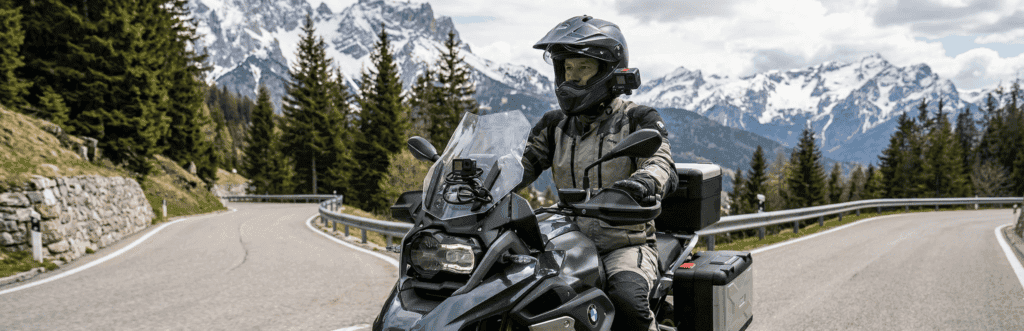
Austria has had a reputation for years for being strict when it comes to dashcams and traffic recordings. Especially when filming gives the impression that you are systematically recording other road users or traffic violations. On top of that, the stories about hefty fines are persistent, and that alone makes it a country where many motorcyclists would rather not be too casual about it.
Switzerland feels similar. Privacy and proportionality are taken very seriously there. Put bluntly: filming the traffic around you “just for fun” is far less self-evident there than it is in the Netherlands.
If you still want to capture beautiful riding footage in countries like these, it is wiser to keep it touristic and restrained. So focus more on landscapes, passes and the route experience, and less on other road users or traffic situations.
Luxembourg and Portugal: I Would Really Be Careful Here
Luxembourg is one of those countries many motorcyclists underestimate. It seems small, relaxed and harmless, but on this point it can actually be quite strict. An active dashcam can cause problems there, precisely because of privacy rules.
Portugal is also known for being sensitive in this area. Filming people and vehicles without clear consent or legal basis is legally much more sensitive there than many travellers expect.
Honestly: if you are going to ride through Luxembourg or Portugal, it is simply wiser not to use an active dashcam as if you were riding in the Netherlands. That helps you avoid hassle, arguments and possibly a serious fine.
A Short Overview by Country
| Country | In practice |
|---|---|
| Netherlands | Usually no problem, mainly watch privacy when publishing |
| Belgium | Fairly similar to the Netherlands, but use as evidence is more sensitive |
| Germany | Allowed to a limited extent, continuous storage is risky |
| Austria | Sensitive and strict, especially with traffic recordings |
| Switzerland | Privacy weighs heavily, filming traffic quickly becomes debatable |
| Luxembourg | Be careful, an active dashcam can cause problems |
| France | Usually less strict, but operating it while riding is of course still unwise |
| Portugal | Very sensitive because of privacy legislation |
Why This Is Especially Relevant for Motorcyclists
As a motorcyclist, you are more vulnerable in traffic. That is exactly why a camera feels appealing. You have evidence if someone overlooks you, cuts you off or simply makes a mistake.
But there is another side to it too. That same footage can also work against you.
If you ride far too fast, overtake riskily or make a stupid move yourself, that will obviously be on the footage as well. In the worst case, you are handing over your own evidence. It is something many motorcyclists would rather not think about for too long, but it is reality.
Filming on the Road? This Is Probably the Sensible Approach
If you mainly want to capture beautiful riding footage, it is smart to keep things practical.
Film mainly for the route experience and scenery, not to actively record other road users. Mount your camera on the motorcycle rather than on your helmet if you want to avoid discussions about approval or injury. Preferably avoid systems that store everything for hours in sensitive countries. And if you are going to publish footage online, make number plates and faces as unrecognisable as possible.
Are you standing still at a busy viewpoint, mountain pass or car park? Then it is sometimes simply easier to turn your camera off for a moment. It avoids hassle, and to be honest, you usually do not miss much there anyway.
So: Is It Simply Allowed?
The honest answer is: sometimes yes, sometimes no, and often it depends on how you use it.
In the Netherlands, you usually get away with it fairly easily. In Germany, you need to pay more attention to how you record and store footage. In Austria, Switzerland, Luxembourg and Portugal, it quickly becomes much less casual.
The safest line for a motorcycle trip through Europe is actually quite simple:
use your camera with restraint, mount it on the motorcycle rather than on the helmet, do not thoughtlessly film everything continuously, and be careful when publishing footage.
That way, you can still enjoy your riding footage without unnecessarily looking for legal trouble on the road.