
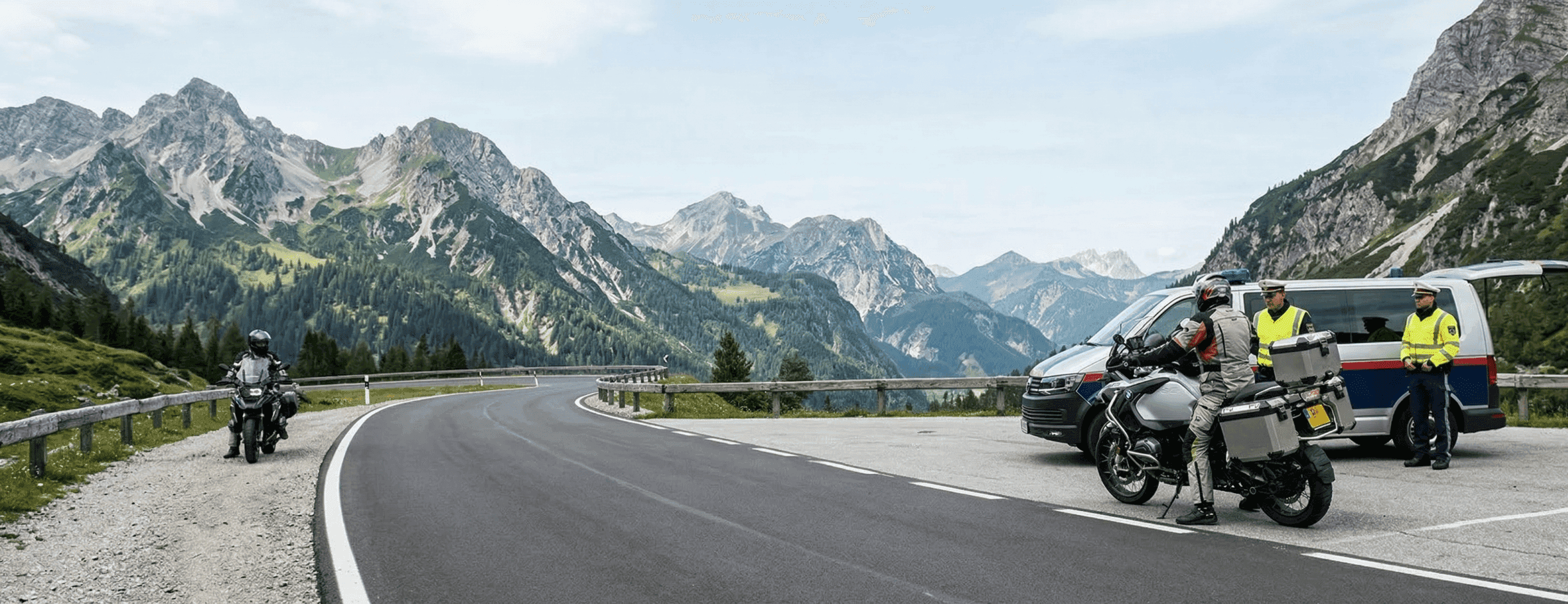
A common mistake is that motorcyclists rely on their own feeling. “It is not that bad, right?” or “It does not sound excessively loud.” But that is not what the police look at. If you want to avoid this kind of surprise on the road, it helps to prepare your motorcycle trip smartly before you leave.
During checks, and especially when it comes to the well-known rules in Tirol, the registered stationary noise is what matters most. That is the value listed in your documents. On your registration card or approval document, you will find it under field U1.
If you have an older motorcycle, pay extra attention. Sometimes there is an N for National after the value. That is where it gets interesting, or rather annoying. In that case, you need to add 21 dB(A) for a comparable measured value. So if it says 80N, in practice you end up at 101 dB(A). And then you are immediately in the range where things can go wrong.
The Police Do Not Only Look at a Measurement
In real life, a check does not always start with a decibel meter. Often it starts much more simply: by looking.
Is the dB killer missing?
Has the exhaust clearly been welded, cut or modified?
Does the E-mark actually match your specific motorcycle?
If something is already wrong there, you are basically in trouble straight away. You do not even need to fail an official noise measurement. If the exhaust or silencer does not match the type approval for your motorcycle, you simply have a problem.
Austria: The Well-Known 95 dB Rule in Tirol
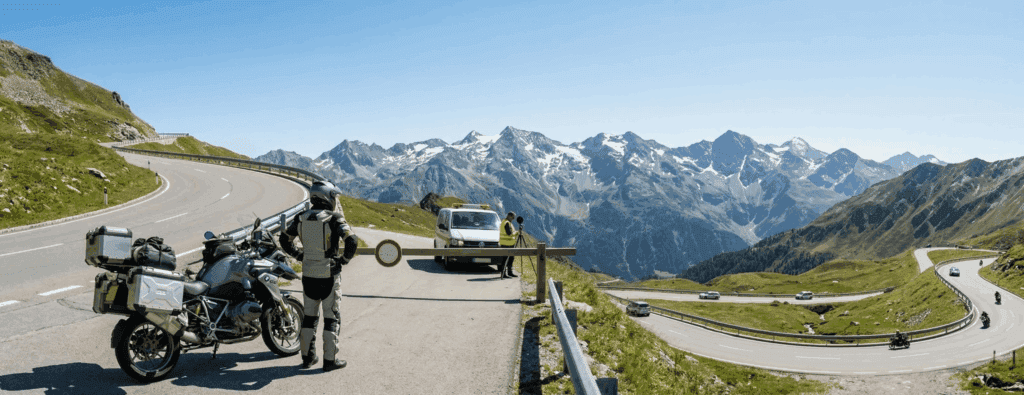
Which Roads Does This Apply To?
In Tirol, seasonal bans apply on a number of routes for motorcycles with a stationary noise of more than 95 dB(A). This ban runs every year from 15 April through 31 October.
And no, as a tourist you do not get an exemption. Not even if you “just need to pass through” or have booked a hotel further along. Foreign motorcycles are covered by the rule as well.
This affects exactly the kind of roads many motorcyclists like to ride. Think of the Hahntennjoch, the Namlosstraße, the Tannheimerstraße and the Lechtalstraße. Places you would normally ride to with pleasure, but where you first need to check carefully whether your motorcycle is even welcome.
What Happens If You Ride There Anyway?
If you ride a motorcycle that is above 95 dB(A) in field U1, and you enter one of those restricted sections, it can cost you money immediately. For violating this specific Tirol route ban, you should expect a fine of around EUR 220. Some German roads are also closed to motorcycles.
And that may be the most frustrating part. Not just the fine, but the simple fact that your route stops there. You have prepared everything, you are on the road, and then you have to turn around.
It is also good to know that a legal sports exhaust usually does not save you here. In Tirol, the value on paper is the basis. So if your motorcycle is registered from the factory at 96 dB(A) or more, you are simply out of luck on those sections. Even if in reality it may sound a bit more civilised with a different silencer.
Riding Without a dB Killer in Austria
If you ride without a dB killer, or with an exhaust that is clearly not legal, things become even more annoying. Then you are not only dealing with the 95 dB rule on certain roads, but the motorcycle may no longer comply with its approved configuration and the Betriebserlaubnis can become invalid.
In other words: formally, you are then riding a motorcycle that no longer meets the requirements. And in that case, fines can rise quickly. There is also a good chance that the police will stop your motorcycle from continuing and your ride will simply be over.
So this is very different from “just getting a warning”. In practice, it can mean that your holiday planning collapses right there.
Germany: No General 95 dB Rule, but Trouble If Your Motorcycle Is Not Legal
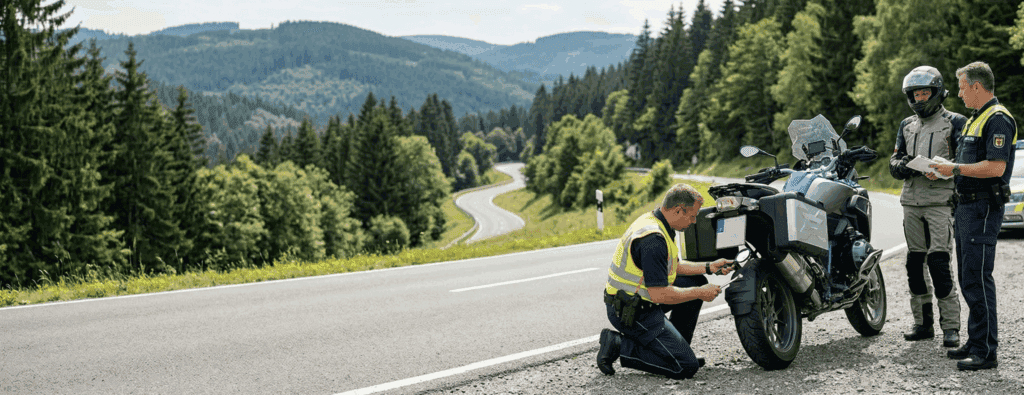
In Germany, It Is Mainly About Technical Condition
Germany takes a slightly different approach. There is no general 95 dB limit like in Tirol, but the police do look closely at the technical legality of your motorcycle. Alongside a legal motorcycle, having the right essential gear for motorcycle trips also makes your trip much more relaxed.
Especially in regions such as the Eifel, the Sauerland and the Black Forest, checks for motorcycle noise take place in many locations, and motorcycle route restrictions exist across Germany. A missing dB killer, an open system without valid approval or an exhaust that does not match the motorcycle can be enough to get you into trouble. If you are heading towards the Eifel, also check our article about riding around Monschau, with beautiful roads, stops and practical points for this region.
According to the rules, your motorcycle’s type approval becomes invalid as soon as a modification negatively affects noise or emissions. That sounds legalistic, but it comes down to something simple: if you have been messing around with the exhaust and it no longer complies, that motorcycle should no longer be on the road in that condition.
Fines Are Annoying, but the Delay Is Often Worse
The fine itself is often not even the biggest drama. Of course it is annoying enough, but what many riders underestimate is that the police can also simply stop your ride.
So imagine you are stopped in Germany and they conclude that your motorcycle is no longer legal. You cannot always simply pay and continue. You may only ride on once the problem has been solved. In practice, that means arranging original parts, refitting the dB killer or having your motorcycle transported away in some other way.
And there goes your day. Or your weekend. The same can happen with bad weather, by the way, so layered motorcycle clothing is at least as important as your technical preparation.
Where Things Often Go Wrong in Practice
The tricky part is that many motorcyclists think an E-mark is automatically enough. But that is not always true. A silencer may have a valid mark and still not be approved for your specific model. And then you are still in the wrong.
Second-hand motorcycles are also a risk. Especially if a sports exhaust is already fitted. Many people assume it must be fine because the previous owner rode it like that too. Do not. Checking it yourself remains the only safe route.
And honestly: riding without a dB killer may sound fun to some people in a tunnel or on a mountain road, but it is simply an extremely stupid risk if you are going to Germany or Austria. You gain practically nothing and can ruin an entire trip with it.
How to Avoid Hassle on the Road
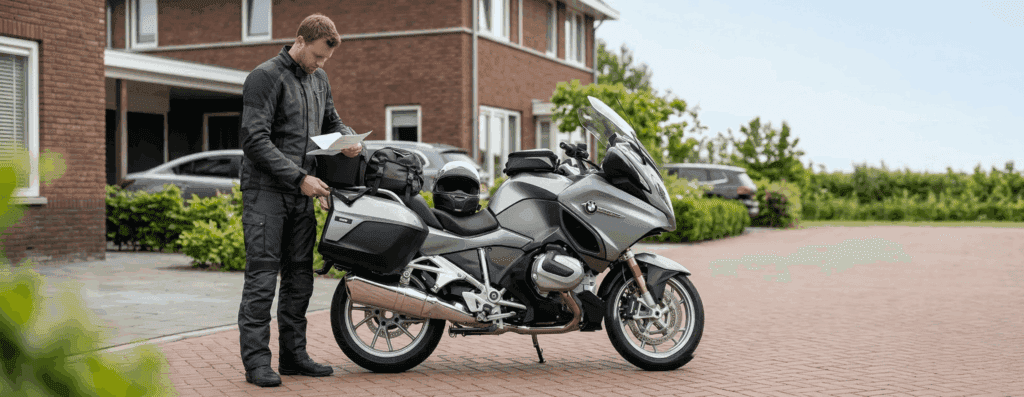
Before you leave, it is smart to calmly check the condition of your motorcycle.
Take your registration card and look at field U1. If you are at 96 dB(A) or higher, you really need to pay attention in Tirol and avoid certain routes between 15 April and 31 October.
If you ride with an aftermarket exhaust, check whether the E-mark is readable and whether that silencer is actually suitable for your motorcycle. If you have documentation for your aftermarket exhaust, it is smart to bring it with you. That is especially useful if a discussion arises on the road, even though such a document is not always mandatory to carry with a correctly marked E-approved exhaust. Make sure that, besides your papers and exhaust documentation, the rest is also in order with this complete motorcycle weekend packing list.
And above all: just leave that dB killer in place. Seriously. This is one of those classic examples of something that may seem “fine enough” at home, but suddenly becomes very expensive and very annoying on the road.
Conclusion
If you are heading to Germany or Austria by motorcycle, it is wise not to treat noise as a side issue. In Tirol, it is simple: if your motorcycle is above 95 dB(A) on paper, some sections are simply off-limits. In Germany, it is less black and white based on one number, but there the focus is on the technical legality of what is fitted to your motorcycle.
The most down-to-earth conclusion is also the best one. Check your papers. Look carefully at your exhaust. Do not rely on what someone says on a forum or what a previous owner told you. In the end, you just want to ride, enjoy the passes and have a good route. Not stand by the roadside arguing about a dB killer you removed at home “for fun”.