

In the Netherlands, motorcyclists usually don’t have to sit at the back of a traffic jam. Carefully filtering between cars is a familiar sight here. Once you cross the border on a motorcycle trip, however, the rules can change considerably. In Belgium and France, lane filtering is permitted under clearly defined conditions. In Germany and Switzerland, you generally have to stay in line. Austria has a limited exception, while Spain is introducing a specific new rule.
Where can you ride between lanes of traffic in Europe, how fast are you allowed to go, and where should you simply stay in the queue? We explain the most important rules for motorcyclists country by country.
This overview was checked on 19 August 2026. Traffic regulations can change. Local road signs and instructions from police and emergency services always take precedence.
What do we mean by lane filtering?
Lane filtering means riding a motorcycle between two rows of stationary or slow-moving vehicles. Depending on the country, you may encounter terms such as lane filtering, lane splitting or, in France, circulation inter-files.
Its legal status varies considerably across Europe. Some countries have specific regulations with clearly defined speed limits. Elsewhere, filtering falls under general overtaking and traffic rules. And in several popular motorcycle destinations, riding between lanes of traffic is simply prohibited.
Motorcycle lane filtering rules by country
| Country | Status | Main rule |
|---|---|---|
| 🇳🇱 Netherlands | ✅ Allowed / code of conduct | Keep the speed difference to roughly 10 km/h and merge back into your lane once traffic is moving faster than around 50 km/h. |
| 🇧🇪 Belgium | ✅ Regulated by law | Maximum 50 km/h and no more than 20 km/h faster than surrounding traffic. |
| 🇫🇷 France | ✅ Allowed under conditions | Maximum 50 km/h; maximum 30 km/h when one of the traffic lanes is stationary. Only on suitable multi-lane roads. |
| 🇬🇧 United Kingdom | ✅ Allowed | Filtering is explicitly recognised in the Highway Code. Keep your speed low and remain particularly alert. |
| 🇦🇹 Austria | ⚠️ Limited permission | You may move past a stationary queue if there is sufficient room and nobody is obstructed or endangered. |
| 🇪🇸 Spain | ⚠️ New rule from 1 October 2026 | No general right to filter. From 1 October, motorcycles may use the right-hand shoulder on specifically designated sections when traffic is stationary, at a maximum of 30 km/h. |
| 🇮🇹 Italy | ⚠️ No specific filtering regulation | Do not assume that common scooter behaviour automatically gives you a legal right to ride between every traffic queue. |
| 🇩🇪 Germany | ❌ Prohibited | Do not ride between cars, use the hard shoulder or ride through the Rettungsgasse. |
| 🇨🇭 Switzerland | ❌ Prohibited | Do not ride between vehicles or pass a stationary queue between lanes. |
Note: “allowed” does not mean that every manoeuvre is automatically legal. Rules regarding speed, road markings, overtaking, lane use and safe riding always continue to apply.
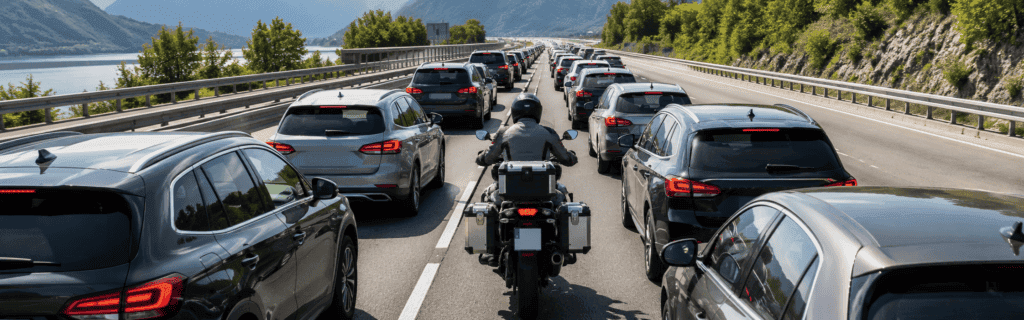
🇳🇱 Netherlands: follow the lane-filtering code of conduct
In the Netherlands, motorcycle lane filtering is not governed by a separate lane-filtering law. The Dutch government does, however, explicitly state that motorcyclists may ride between cars in a traffic jam. Riders are expected to follow the lane-filtering code of conduct developed by the Dutch Motorplatform.
- Keep the speed difference to approximately 10 km/h compared with surrounding traffic.
- Merge back into the lane once traffic begins moving faster than approximately 50 km/h.
- On roads with three or more lanes, use the space between the two leftmost lanes.
- Do not use the hard shoulder or hatched areas to pass the queue.
If traffic is completely stationary, this guideline therefore means filtering at roughly 10 km/h. If the queue is moving at 30 km/h, keep your speed at around 40 km/h.
🇧🇪 Belgium: maximum 50 km/h and a 20 km/h speed difference
Belgium has much clearer legal rules for motorcycle lane filtering. Motorcyclists may ride faster between two rows or queues of stationary or slow-moving traffic.
- The motorcycle may travel at a maximum of 50 km/h.
- The speed difference compared with surrounding traffic may not exceed 20 km/h.
- On motorways and expressways, ride between the two leftmost lanes.
Example: if traffic is completely stationary, you may ride at up to 20 km/h. If traffic is moving at 20 km/h, you may ride at up to 40 km/h. Once traffic reaches 30 km/h, the absolute maximum of 50 km/h becomes the limiting factor.
🇫🇷 France: nationwide rules since 2025
France experimented with motorcycle lane filtering for several years. Since 11 January 2025, circulation inter-files has been permitted nationwide, but only under clearly defined conditions.
- The rules apply on motorways and other roads with physically separated carriageways and at least two lanes in each direction where the normal speed limit is at least 70 km/h.
- You must ride between the two leftmost lanes.
- The maximum speed while filtering is 50 km/h.
- If one of the traffic lanes is completely stationary, the maximum speed drops to 30 km/h.
- You may not overtake another motorcycle that is itself filtering by using the inter-lane space.
- Filtering is prohibited in conditions such as snow or ice.
Once traffic begins flowing normally again, you must leave the filtering position and return to a normal position within a traffic lane.
🇩🇪 Germany: stay in the queue
For riders travelling through Europe, Germany is one of the most important countries to remember. What is perfectly normal in countries such as the Netherlands is not permitted here.
Riding a motorcycle between rows of vehicles (Durchschlängeln) is prohibited. According to the ADAC, this is considered, among other things, unlawful overtaking on the right. Passing a queue on the far left may theoretically be possible if it can be carried out as a normal overtaking manoeuvre with sufficient clearance, but in a real motorway traffic jam there is rarely enough space to do so legally.
- Do not ride between rows of cars.
- Do not use the hard shoulder to move to the front.
- Never use the Rettungsgasse.
The simplest rule to remember in Germany is therefore: traffic jam = stay in line.
🇦🇹 Austria: more is allowed than many riders think
Austria is often grouped together with Germany when lane-filtering rules are discussed, but the regulations are different.
According to the Austrian ÖAMTC, a motorcyclist may move forward past a stationary queue of vehicles when this can be done in accordance with traffic regulations, there is sufficient space and other road users are neither obstructed nor endangered.
This can be done alongside or between stationary vehicles. It does not, however, give motorcyclists a general right to continue filtering through slow-moving motorway traffic in the same way they might in the Netherlands.
And in Austria too, the Rettungsgasse remains reserved for emergency services.
🇨🇭 Switzerland: don’t ride between the cars
Switzerland takes a much stricter approach. The Swiss TCS clearly advises motorcyclists not to ride between cars or pass a stationary queue between traffic lanes.
This is particularly worth remembering around notorious bottlenecks such as the Gotthard Tunnel. No matter how tempting that gap between the cars looks on a hot summer day: stay in the queue in Switzerland.
🇬🇧 United Kingdom: filtering is part of everyday traffic
In the United Kingdom, filtering is a well-known and accepted manoeuvre. The official Highway Code even refers specifically to motorcyclists filtering through traffic in Rule 88.
There is no fixed 20 km/h speed-difference rule like the one used in Belgium. The emphasis is on maintaining a low, safe speed and continually anticipating the actions of other road users.
- Watch for vehicles changing lanes unexpectedly.
- Look out for pedestrians crossing between stationary vehicles.
- Make sure drivers have a chance to see you in their mirrors.
- Remember that traffic drives on the left.
🇪🇸 Spain: important change from 1 October 2026
Spain deserves some extra attention in 2026 because a new rule is on its way that, at the time of writing, is not yet in force.
A new Spanish traffic regulation has already been published but will only come into effect on 1 October 2026. From that date, motorcycles may be permitted to use the right-hand shoulder on specifically designated sections when normal traffic has come to a complete standstill because of congestion.
- The road section must be specifically designated and signposted for this purpose.
- Traffic in the normal lanes must be stationary due to congestion.
- The maximum speed is 30 km/h.
- Motorcycles must travel one behind another rather than side by side.
- Road users who need to use the shoulder because of their function or situation must not be obstructed.
Important: on 19 August 2026, this new Spanish exception is not yet in force. It takes effect on 1 October 2026.
Even after 1 October, this does not mean that every Spanish hard shoulder automatically becomes a motorcycle lane whenever traffic stops. Without the correct designation and signage, you cannot simply use it.
🇮🇹 Italy: don’t simply copy the locals
Ride through an Italian city and you could easily get the impression that motorcyclists and scooter riders are allowed to squeeze through every available gap. Filtering is certainly a very visible part of everyday traffic.
Italy does not, however, have the same separate and clearly defined lane-filtering system as countries such as Belgium or France. General rules regarding overtaking, lane use, road markings and safe riding remain decisive.
Our practical rule: do not treat the behaviour of local scooter riders as proof that a manoeuvre is legally permitted. In particular, don’t simply use the hard shoulder as an alternative motorcycle lane.
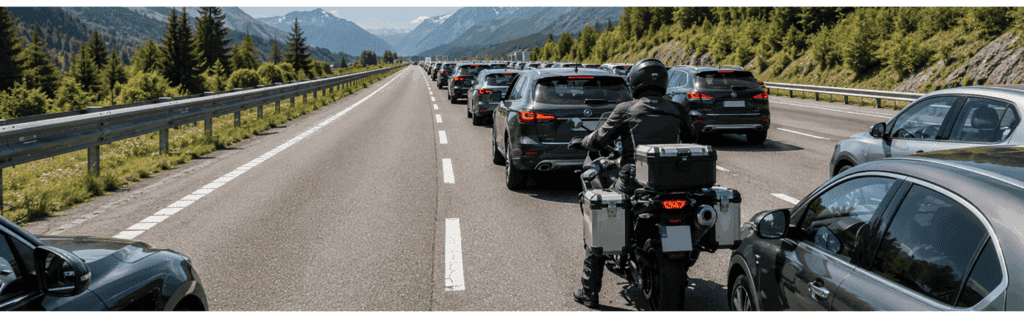
The Rettungsgasse is not a motorcycle lane
The Rettungsgasse, or emergency corridor, is particularly important in Germany and Austria. When traffic comes to a standstill, drivers create a clear corridor between the leftmost lane and the lane immediately to its right so that emergency vehicles can get through.
From a motorcycle seat, that empty space may look like the perfect route through the traffic jam, but it is absolutely not intended for motorcyclists.
Ambulances, fire engines, police vehicles, recovery vehicles and other emergency services must be able to move through congestion without obstruction. The fact that your motorcycle fits easily through the gap does not turn it into a motorcycle lane.
How much can illegal lane filtering cost?
A single European table of lane-filtering fines may sound useful, but it can also be misleading. The actual penalty often depends on the exact offence, the circumstances, whether anyone was endangered and whether you also used a hard shoulder or emergency corridor.
A few current examples show that the penalties can nevertheless become substantial:
- Germany: according to the ADAC, normal Durchschlängeln through a traffic jam can result in a €100 fine plus one penalty point.
- Germany: illegally riding through the Rettungsgasse starts at €240, two penalty points and a one-month driving ban. Penalties increase if emergency services are obstructed or others are endangered.
- France: breaking the rules for circulation inter-files is classified as a fourth-class offence, with a standard fine of €135.
For the other countries, we deliberately do not list generic fine amounts because the same filtering manoeuvre can fall under different offences depending on the circumstances.
The most important rules at a glance
- 🇳🇱 Netherlands: keep the speed difference to roughly 10 km/h.
- 🇧🇪 Belgium: maximum 20 km/h speed difference and never faster than 50 km/h.
- 🇫🇷 France: maximum 50 km/h, or 30 km/h when one lane is stationary, and only on suitable roads.
- 🇩🇪 Germany: do not filter through traffic; both the Rettungsgasse and hard shoulder are off-limits.
- 🇦🇹 Austria: passing a stationary queue may be permitted under certain conditions, but there is no general right to filter through moving traffic.
- 🇨🇭 Switzerland: do not ride between the cars.
- 🇬🇧 United Kingdom: filtering is permitted, but keep your speed low.
- 🇪🇸 Spain: new 30 km/h rule for specifically designated shoulders from 1 October 2026.
Check the rules before you leave
The differences between European countries are considerable. During a single day’s ride, you can cross from a country with clearly defined lane-filtering rules into another where exactly the same manoeuvre is prohibited.
This can happen when travelling through the Netherlands, Belgium and France, or when a trip to the Alps takes you through Germany, Austria, Switzerland and Italy.
Before setting off, don’t just check speed limits, mandatory equipment, low-emission zones and toll regulations. Also check what you are allowed to do on your motorcycle when the motorway comes to a complete standstill.
Sitting at the back of a traffic jam in the heat isn’t much fun. A hefty foreign traffic fine during your motorcycle holiday is even worse.
Sources: Dutch Government and ANWB (Netherlands), Belgian Traffic Code, Sécurité Routière (France), ADAC (Germany), ÖAMTC (Austria), TCS (Switzerland), GOV.UK Highway Code and the Spanish Boletín Oficial del Estado. Last checked: 19 August 2026.