
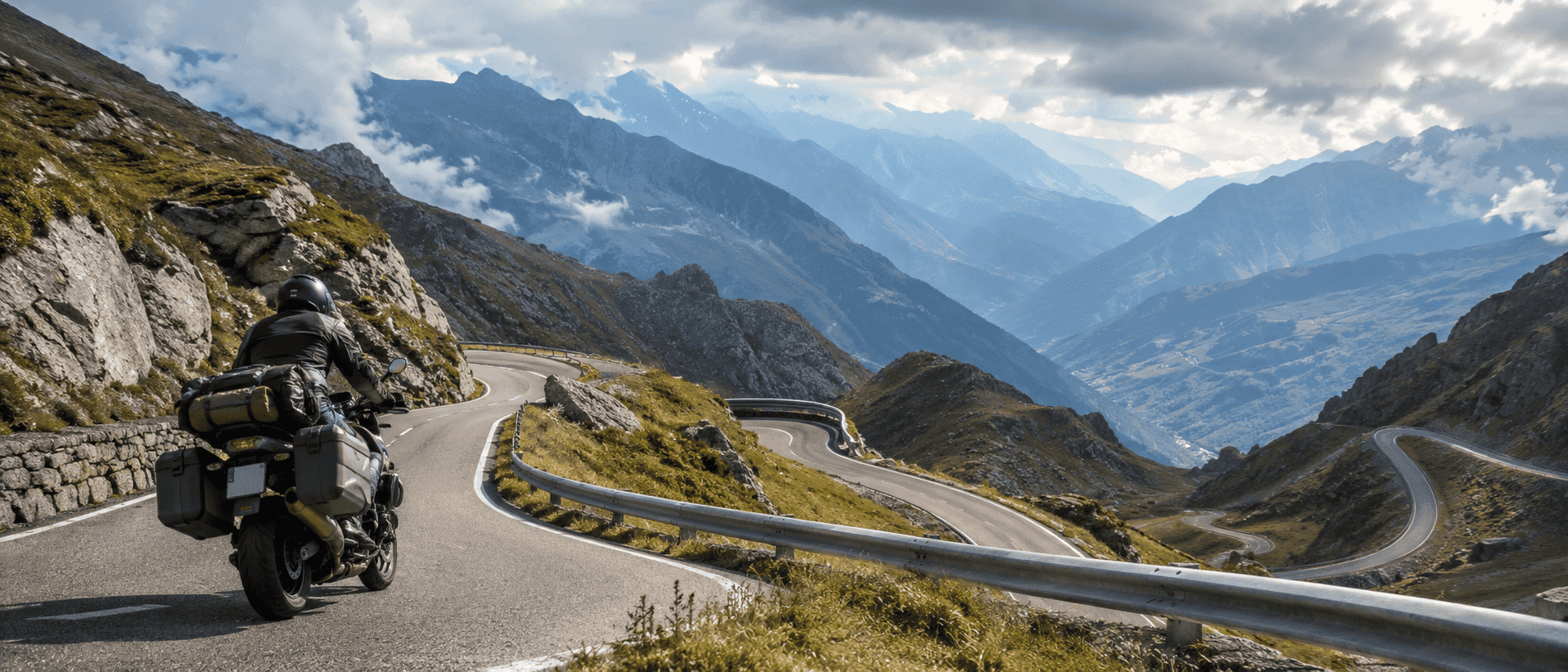
Planning a motorcycle trip in the mountains is a little different from planning a weekend ride in the Netherlands, Belgium or another mostly flat area. Not because it has to be complicated, but because distance, elevation changes, weather and fatigue have a much bigger impact on your day. For mountain riding, it is usually better to plan slightly shorter and more flexible riding days than you might be used to at home.
Expect a lower average speed, rapidly changing weather, possible mountain pass closures and more fatigue. It is also important not to rely entirely on one fixed route.
On paper, 250 kilometres may look like an easy stage. In the Alps or Pyrenees, however, it can quickly turn into a demanding day of riding. If you are travelling for several days in a row, it is worth preparing not only your GPX routes but your entire motorcycle trip properly.
How many kilometres should you ride per day in the mountains?
Distance alone does not tell you much in the mountains. A 220-kilometre mountain ride can be physically and mentally more demanding than a much longer ride on motorways and flat roads. You are constantly braking, downshifting, choosing your line, judging traffic and looking ahead to the next blind corner.
Add a few mountain passes, photo stops, roadworks, fuel stops and a lunch break, and your average speed quickly drops below what you may be used to at home. We once rode around 230 km of Swiss mountain passes in very hot weather, for example, and it turned into a surprisingly intense day of riding. You can watch our video here.
So think in terms of riding time rather than distance alone.
- A daily distance of around 200 to 300 kilometres can already be more than enough for a proper mountain day if the route includes several passes and lots of twisty back roads. If it is your first motorcycle trip to the mountains, we recommend keeping it to a maximum of around 200 km.
- A relatively short route can still take an entire day if you stop regularly and spend most of the time away from faster main roads.
- Riding several days in a row? Do not plan every day to the absolute maximum. One demanding day in the twisties is great fun, but several heavy days back-to-back will eventually affect both your concentration and enjoyment.
Our approach: we would rather plan slightly too few kilometres than too many. If the route takes less time than expected, there is usually another scenic detour, viewpoint or extra mountain pass nearby. The other way around is much less enjoyable: getting tired late in the afternoon while still having another hundred kilometres that you have to ride. And in the mountains, 100 km is rarely just another hour on the bike.
A good motorcycle trip is not about covering as many kilometres as possible. It is about riding routes that remain enjoyable from the first corner to the last.
Check mountain passes and road closures
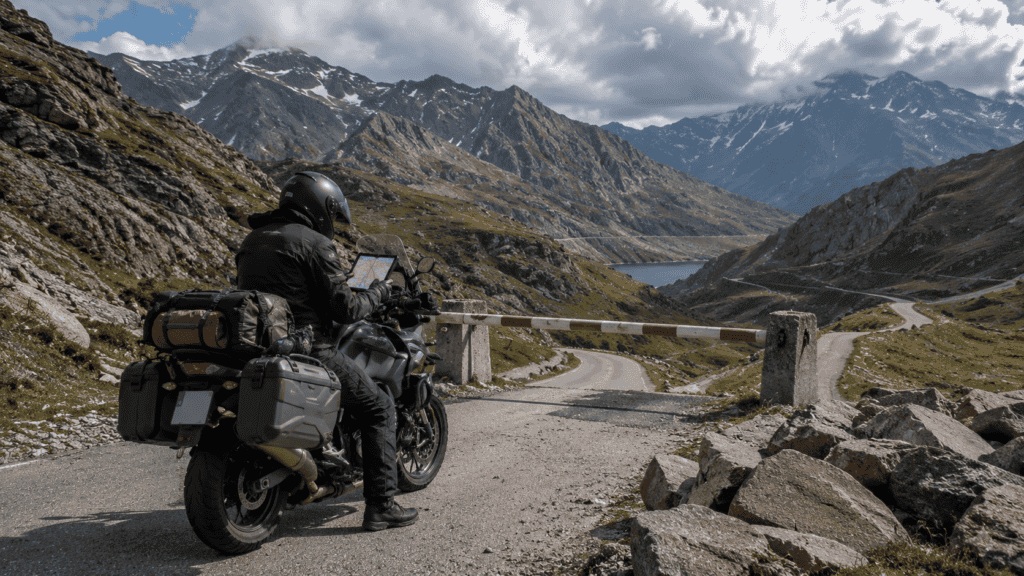
Mountain passes are often the literal and figurative highlights of a motorcycle trip, but you cannot simply assume that every pass will be open. Snow, bad weather, roadworks, events or accidents can suddenly make your planned route impossible. It has happened to us too.
It is especially important to check conditions early and late in the riding season. High mountain passes may still be closed because of snow, while temporary roadworks or changing weather conditions can cause problems even in the middle of summer.
With our MM Route Checker, you can check your GPX file for road closures, motorcycle restrictions, noise restrictions and closed mountain passes on or near your route. Do not just check important passes while planning your trip at home. Check again shortly before departure and, ideally, once more on the morning you actually plan to ride them. Conditions in the mountains can change quickly.
Use our tools as a helpful starting point and, when in doubt, always check the latest information from local or official sources as well.
Always have an alternative route
A Plan B may sound as though you are already expecting the day to go wrong, but that is not how you should look at it. For important mountain stages, simply make sure you know beforehand where you can go if a pass turns out to be closed. That could mean using another mountain pass, taking a quicker route through the valley or along a motorway, or shortening your planned loop. The important thing is that you do not have to start figuring out your options when you are already standing in front of a barrier or road closure.
A good alternative does not have to mean a boring motorway detour either. Sometimes Plan B turns out to be quieter and even more enjoyable than the original route.
Plan in advance:
- which mountain passes you most want to ride;
- which alternative roads are available if a pass is closed;
- where you can easily shorten the route;
- and at what point turning around makes more sense than taking a huge detour.
Practical checklist for a day in the mountains
When planning a motorcycle route through the mountains, these are some of the things we always take into account:
It may sound like a lot to think about, but during the planning stage it hardly takes any extra time. Once you are on the road, that extra margin makes the trip much more relaxed.
How much luggage should you take to the mountains?
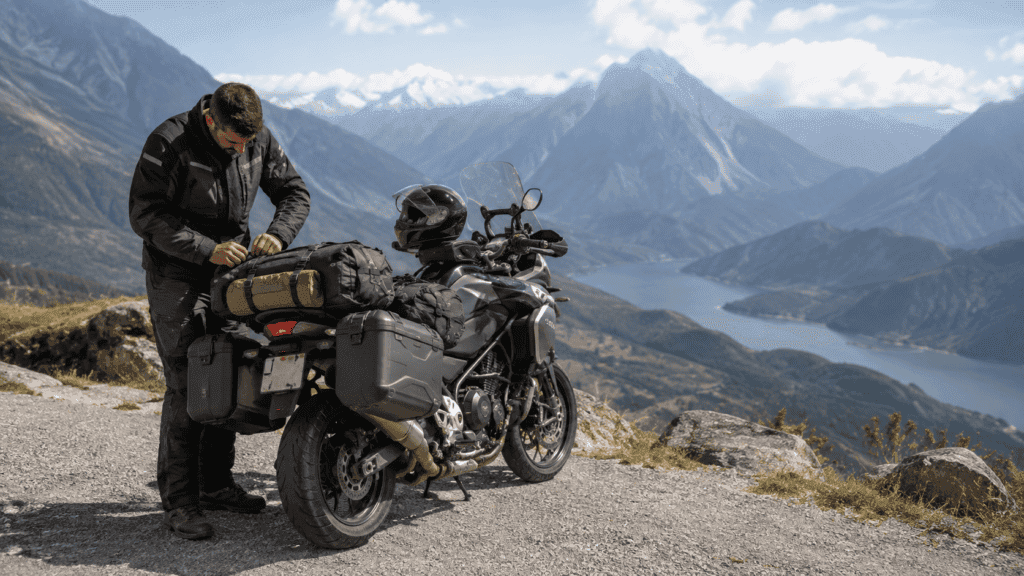
You notice extra weight more in the mountains than during a relaxed motorway ride. A heavily loaded motorcycle behaves differently when braking, turning and manoeuvring at low speeds. Tight hairpin bends or turning around on a steep slope quickly show just how awkward a top-heavy bike can become.
So do not automatically pack everything simply because you can find room for it at home. Place the heaviest items as low and as centrally as possible on the bike, and avoid having one pannier significantly heavier than the other.
Also make sure the things you may need quickly during the day remain easy to reach:
- rain gear;
- drinking water;
- an extra pair of dry or warmer gloves;
- sunglasses or a suitable visor;
- an extra clothing layer;
- a few small snacks;
- documents and your wallet.
Not sure what you actually need? Use our motorcycle trip packing list as a starting point. And remember: everything you decide to pack at home has to come with you through every hairpin bend later.
Motorcycle clothing for changing mountain weather
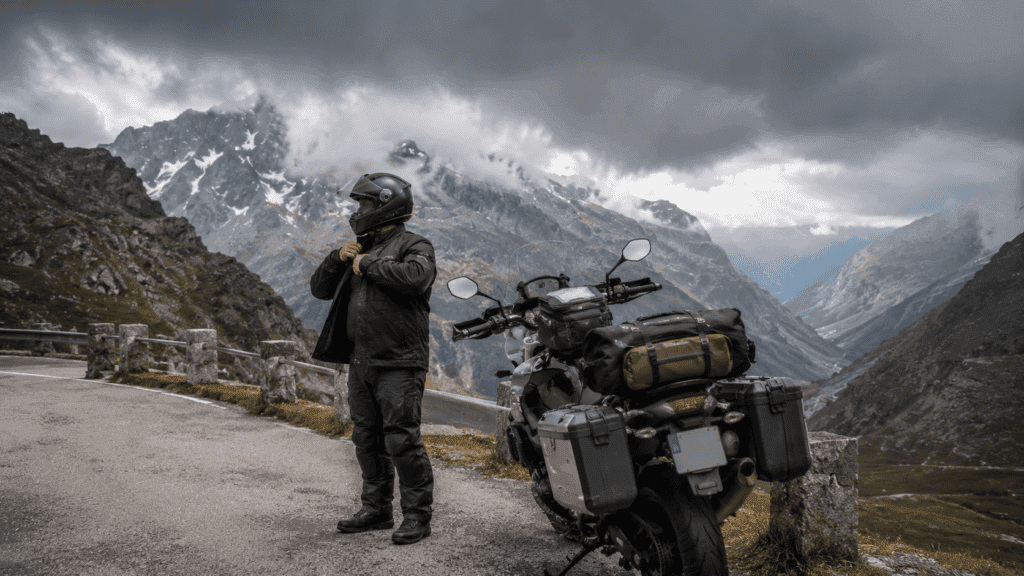
One of the biggest differences compared with riding in flatter areas is how much the weather can change within a single day. It may be pleasantly warm down in the valley, while a short time later you find yourself dealing with cold temperatures, strong winds, fog or rain at the top of a high mountain pass.
That is why we prefer to use multiple clothing layers that can easily be added or removed during the day:
- Base layer: for example, thermal underwear that wicks moisture away effectively. We use these merino wool shirts; they are good and inexpensive.
- Mid layer: an insulating layer that is easy to put on or take off.
- Outer layer: your protective motorcycle clothing, supplemented with waterproof gear if your motorcycle suit is not sufficiently waterproof.
In our detailed guide to layered motorcycle clothing, we explain in more detail how to use this system in practice.
Most importantly, do not bury your rain gear at the bottom of a completely packed pannier. If the sky above the next mountain ridge suddenly turns dark, you want to be able to reach it before the rain really starts.
Take breaks before you get tired
In the mountains, you sometimes do not notice fatigue until you have already been riding for too long. Because you are constantly thinking about your line, oncoming traffic, the road surface and the next corner, your concentration gradually starts to drop.
So do not wait until your wrists start hurting or you notice that your riding is becoming less precise.
- Stop regularly. During an intensive mountain day, shorter breaks often work better than riding for hours without stopping.
- Eat and drink in time. Do not wait until you are already thirsty or hungry.
- Actually get off the bike. Moving around for a few minutes can already be enough to feel refreshed before continuing.
- Fill up when it is convenient. In remote areas, do not wait until your fuel warning light has been on for a long time.
Leave room in your plans for bad weather
Mountain weather can change quickly. You might leave in the morning under a perfectly blue sky and find yourself riding through rain, fog or thunderstorms only a few hours later.
So do not only check the weather forecast for the place where you are staying. Also look at:
- the weather at the highest points of your route;
- the risk of thunderstorms later in the day;
- wind conditions on higher mountain passes;
- and the weather on the other side of the mountain range.
By leaving enough flexibility in your schedule, you can wait out a heavy shower somewhere comfortable or adjust your route without immediately causing problems with your next overnight stop.
What is the best time to ride the Alps?
For many motorcycle trips through the Alps, June to September is the most practical period, although conditions can still vary considerably within those months.
- May and June: high mountain passes may still be closed after a winter with heavy snowfall. Lower routes are often already accessible, and it is usually quieter than in the middle of summer.
- July and August: most high mountain passes are generally accessible, but this is also the busiest holiday period. Popular passes in particular can become crowded with cars, camper vans, cyclists and motorcycles.
- September and October: roads can be much quieter, but the days become shorter and the chances of low temperatures, overnight frost and early snowfall at altitude increase.
There is no single perfect month. Consider the regions and mountain passes you want to ride and check the latest conditions shortly before departure.
Check your route again shortly before departure
A GPX route you created several months before your trip may no longer be completely up to date on the day you ride it. A road may have closed, a mountain pass could be temporarily inaccessible or a new restriction may have been introduced.
The evening before: check the route for the following day, look at the weather forecast and, if necessary, run your GPX through the MM Route Checker again.
A few minutes of checking can save you a major detour or a ride all the way up to a closed mountain pass.
Tick off less, enjoy the ride more
It is tempting to try to tick off as many famous mountain passes as possible during a motorcycle trip. Stelvio, Grossglockner, Susten, Grimsel, Furka: if you are already in the area, naturally you want to ride them all.
But a day where you rush across six famous passes and arrive exhausted is not automatically better than a ride with three beautiful passes where you have time for coffee, a viewpoint or an unexpectedly great side road. Plan with some breathing room. The weather can change, a road can close and sometimes, after a few intensive days of riding, you simply feel like taking it a little easier. Having that flexibility is exactly what keeps a motorcycle trip in the mountains enjoyable.
Ultimately, the best mountain route is not the one where you ticked off the most kilometres or mountain passes. It is the one where you get off the bike at the end of the day and think: I would happily ride that exact route again tomorrow.