
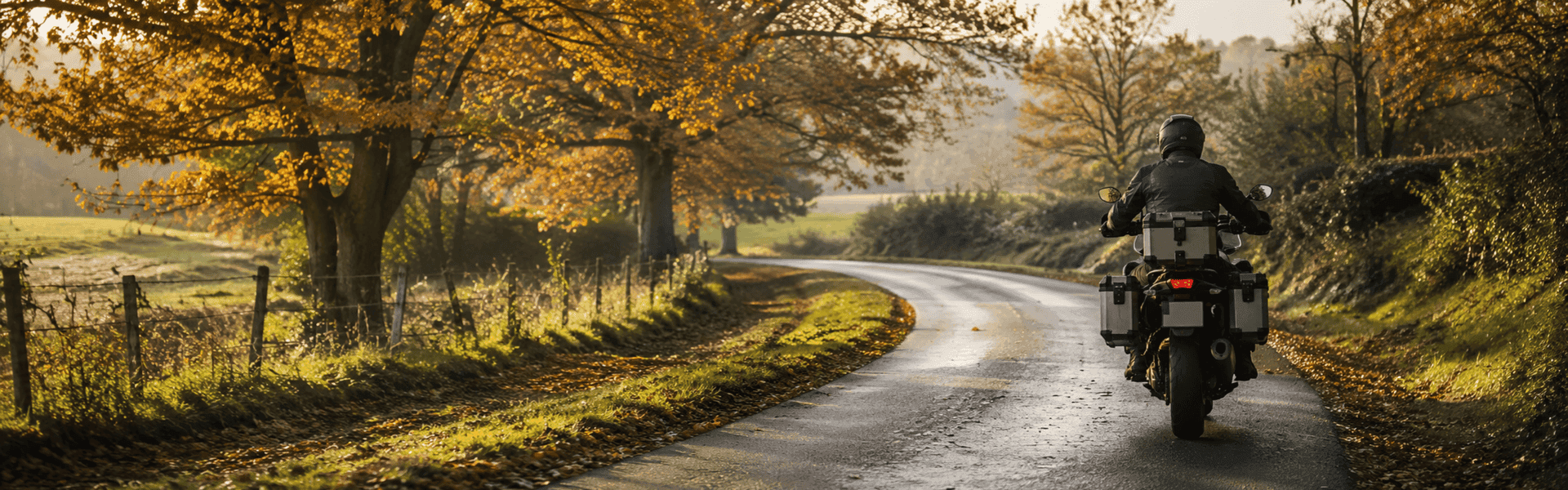
Autumn can be one of the best times of year to ride a motorcycle. The roads are often quieter, the landscape changes visibly and, on a clear day, the temperature can be far more comfortable than during a hot summer ride. At the same time, an autumn motorcycle ride requires a little more attention. A route that is straightforward in July can feel completely different when wet leaves, mud, mist and low sunlight enter the equation.
That does not mean you need to put the motorcycle away as soon as the first leaves begin to fall. With a sensible route, a carefully chosen departure time and a few basic checks, you can still enjoy some fantastic riding throughout September, October and sometimes well beyond.
Why motorcycling in autumn is different
The biggest difference is not simply the lower temperature. During autumn, several changing conditions begin to overlap. The road surface warms more slowly, moisture remains for longer and the difference between a sunny section of asphalt and a shaded one can be considerable.
The route itself changes too. Leaves collect on and just beyond bends along forest roads. In rural areas, agricultural vehicles may leave mud and crop residue on the road. Bridges, dykes and exposed sections are more affected by wind, while low-lying roads may remain damp or misty for much longer.
Autumn therefore does not necessarily call for less riding. It mainly calls for smarter planning and smoother riding.
Choose your route for the conditions, not only the bends
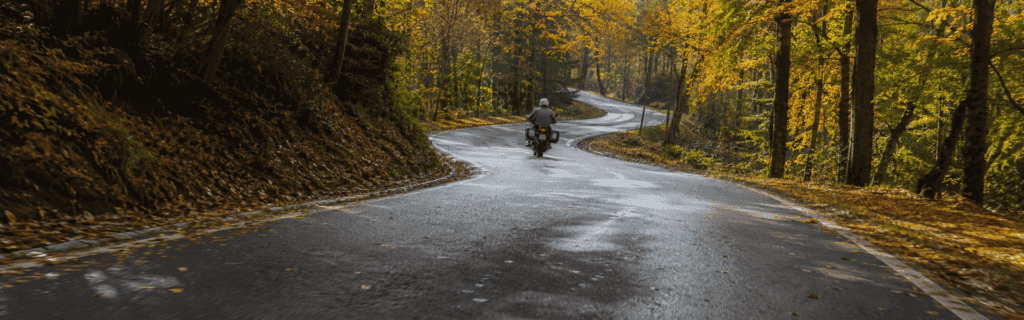
A beautiful autumn afternoon makes a heavily wooded route tempting. The colours can be fantastic, but the asphalt beneath trees often remains wet for much longer. Leaves can also hide potholes, gravel and other contamination.
During changeable weather, it is therefore better to choose a route with enough open sections and wider through-roads. You do not need to avoid every attractive forest road, but it is sensible not to make them the only ingredient of your ride.
- Avoid a route that runs almost entirely through dense forest if it has rained heavily beforehand.
- Be particularly cautious on narrow agricultural roads during harvest season.
- Plan an easy way to shorten the route.
- If mist is likely, do not automatically choose the lowest roads beside rivers and canals.
- Check whether roadworks or closures could divert you onto narrow and potentially dirty roads.
Already created a GPX file? Run it through the MM Route Checker before departure. It is better to discover possible road closures, restrictions and other points of attention at home than while standing beside a wet road closure.
Do not automatically leave early in the morning
During summer, leaving early is often ideal. In autumn, the decision is less straightforward. After a cold or damp night, mist, dew and a cold road surface can be most noticeable during the morning.
For a recreational autumn ride, leaving later in the morning is often more comfortable. The temperature has had time to rise, any mist may have started to clear and parts of the road surface may have dried.
Keep the other end of the day in mind as well. The sun sets earlier and the temperature can drop quickly towards the end of the afternoon. Do not make your route so ambitious that you are forced to complete the final hour in cold conditions, fading light or mist.
Low sunlight: your own visibility is only half the story
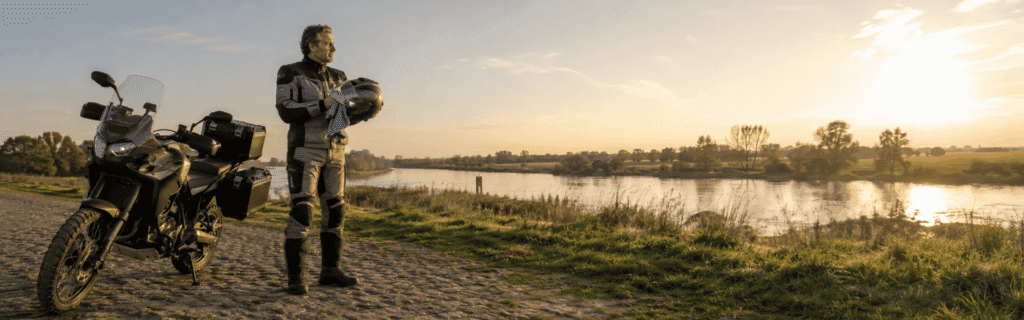
Low sunlight can reduce your visibility within seconds. A clean, scratch-free visor helps because dirt and scratches scatter the light even further. An integrated sun visor can be useful, provided you can raise it immediately when entering a dark forest section or tunnel.
Also consider traffic approaching from the opposite direction and vehicles waiting at side roads. When the sun is behind you, other road users may be looking directly into it. Do not automatically assume that someone has seen you, even when your lights are working correctly.
- Clean both the inside and outside of your visor before departure.
- Do not use a dark visor if your ride may continue into dusk.
- Increase your following distance when visibility changes between sunlight and shade.
- Be especially cautious at junctions when other road users are facing the sun.
Check your tyres before the ride

The condition of your tyres becomes even more important when temperatures fall and the road is wet. Check the pressure while the tyres are cold and use the value specified by the motorcycle manufacturer for your motorcycle, load and type of use. Do not rely on guesswork and do not deliberately reduce the pressure in an attempt to create more grip.
Check the tread, damage and uneven wear at the same time. The legal minimum should not be treated as the ideal starting point for a wet autumn season. As tread depth decreases, the tyre becomes less effective at dispersing water.
Do not assume that weaving from side to side will safely warm your tyres. Simply begin the ride calmly, brake and accelerate smoothly and give both the tyres and road surface time to earn your confidence.
How to deal with wet leaves, mud and slippery sections
A single dry leaf is not usually the main problem. A compressed layer of wet leaves can, however, become extremely slippery. The difficult part is that you cannot always see what lies underneath it.
Look well through the bend and try to identify contamination early. If you need to cross a slippery or dirty section, keep the motorcycle as upright as possible and avoid sudden braking, acceleration or steering. Reduce your speed smoothly before reaching the affected section.
The same applies to mud carried from fields by agricultural vehicles. After rain, this layer can be much more slippery than the surrounding asphalt. In rural areas, watch for tyre tracks, warning signs, tractors and sudden changes in the colour of the road surface.
Adjust your pace without becoming tense
Riding cautiously does not mean sitting rigidly and tensely on the motorcycle. A relaxed posture actually makes it easier to steer smoothly and absorb small movements from the bike.
- Look farther ahead so you can react earlier and more smoothly.
- Leave more distance between yourself and other traffic.
- Complete most of your braking before entering a bend.
- Build the throttle gradually once you can see through the exit.
- Reduce your lean angle when grip or road contamination is difficult to judge.
- Do not allow a faster rider behind you to push you beyond your own pace.
A good autumn ride is not about proving that you can maintain the same pace in every condition. The aim is to keep the ride controlled and enjoyable from beginning to end.
Clothing: do not let the cold take over your concentration
The temperature can change considerably within a few hours during autumn. An extra layer may feel unnecessary when you leave, but become very welcome later on an exposed dyke or shaded forest road.
Use clothing layers that can be added or removed easily. Our guide to essential motorcycle trip clothing and equipment explains how to prepare for changing temperatures and weather conditions.
Carry a dry pair of gloves if rain is possible and do not bury your waterproof clothing at the bottom of a fully packed pannier. The MM Packing List helps you tailor your equipment to the season, destination and length of your trip.
Make the route shorter than you would on a summer day
Autumn conditions demand more concentration. You spend more time assessing the road surface, visibility, temperature and possible contamination. A ride of the same distance can therefore feel more tiring than it would during summer.
Plan one well-balanced loop rather than a route that only works if everything goes perfectly. Choose a logical point where you can shorten the ride and identify places where you can stop somewhere warm and dry.
Looking for a region that can also work well for a compact autumn ride? Explore the best motorcycle regions just across the German border. Always check the weather and current route conditions again before departure.
Checklist before an autumn motorcycle ride
- Check the weather forecast for the entire route, not only your home town.
- Review temperature, visibility, rain and wind for each part of the day.
- Measure the tyre pressure while the tyres are cold.
- Inspect the tread, tyres and motorcycle lighting.
- Clean your visor and carry a suitable anti-fog solution.
- Keep an additional clothing layer and waterproofs within easy reach.
- Create a shorter route option or clear shortcut.
- Check your GPX route for closures and restrictions.
- Make sure you can return well before dark.
When is it better to leave the motorcycle at home?
Not every attractive route needs to be ridden. If there is a risk of ice, dense fog, storm-force winds or a combination of low temperatures and prolonged heavy rain, postponing the ride is often the sensible choice.
That is not a missed motorcycle ride. It is simply good route management. A dry autumn day later in the week will probably be more enjoyable and require less risk and concentration.
Frequently asked questions about autumn motorcycle riding
A few loose, dry leaves do not immediately create a major problem. A thick, compressed and wet layer can be extremely slippery and may conceal gravel, potholes or mud. Avoid abrupt braking or steering and, where possible, cross the affected section with the motorcycle upright.
No, not unless the manufacturer specifically instructs you to do so. Check the pressure while the tyres are cold and follow the specified value for your motorcycle and load. Deliberately running a lower pressure can adversely affect handling and tyre temperature.
Late morning through to the middle of the afternoon is often the most comfortable period. Mist and dew have more time to clear, while you can return before the strongest cooling and fading light. Always check the local forecast for the day of your ride.
Autumn does not have to end your motorcycle season
With a suitable route, clear visibility, correct tyre pressure and a little more margin, an autumn motorcycle ride can be particularly rewarding. You do not need to fear every leaf on the road, but you should not treat the conditions as if it were still the middle of summer either.
Plan a more compact route, leave at a sensible time and keep enough flexibility to adapt your ride. Explore our motorcycle routes for inspiration and check your chosen GPX file again shortly before departure. Autumn can then remain exactly what it should be: another beautiful chapter in your motorcycle year.