
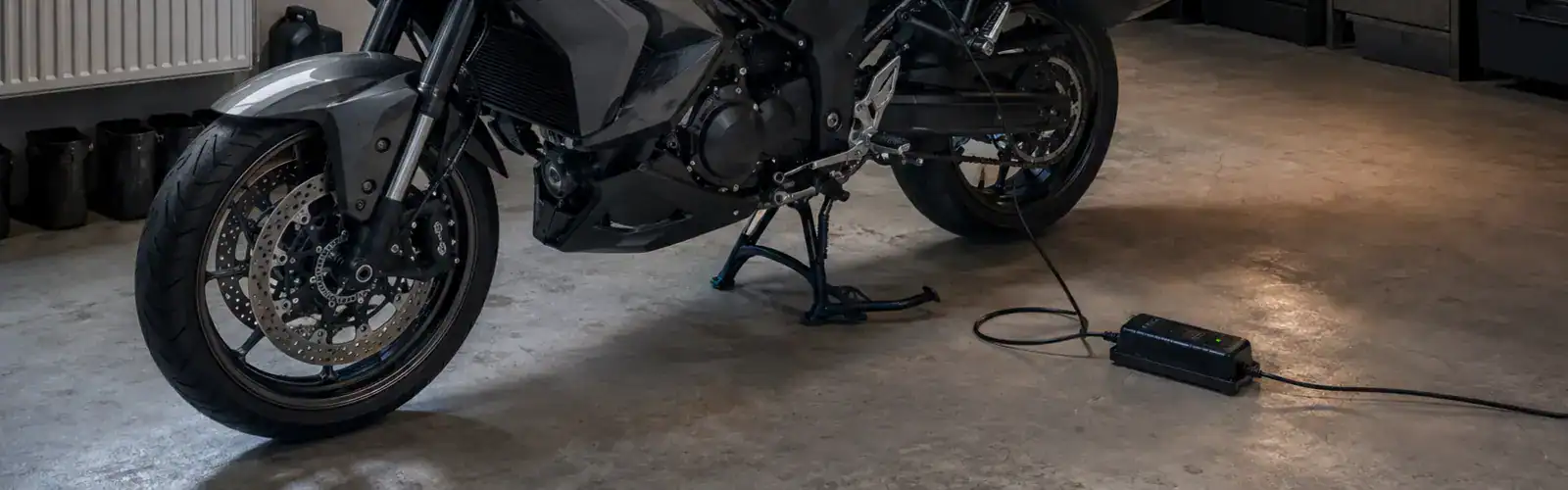
You turn the key after several months of winter storage, only to hear a tired click. A flat or weakened battery is one of the most common problems riders encounter on the first beautiful day of spring. Self-discharge and parasitic drain from the motorcycle’s electronics can gradually reduce the battery voltage during winter storage. With the right approach, you can prevent unnecessary capacity loss and increase the likelihood that your motorcycle will start immediately in spring.
Why does a motorcycle battery lose charge during winter storage?
Even a disconnected battery slowly loses some of its charge through internal chemical processes. This is known as self-discharge. If the battery remains connected to the motorcycle, a small but continuous parasitic drain may also occur. Possible causes include:
- the immobiliser;
- the clock and memory functions;
- keyless electronics;
- the alarm system;
- a GPS tracker;
- aftermarket accessories.
This is usually not a problem during the riding season because the alternator recharges the battery while you ride. However, if the motorcycle remains unused for several weeks or months, its state of charge can continue to decline.
Why deep discharge is harmful to a battery
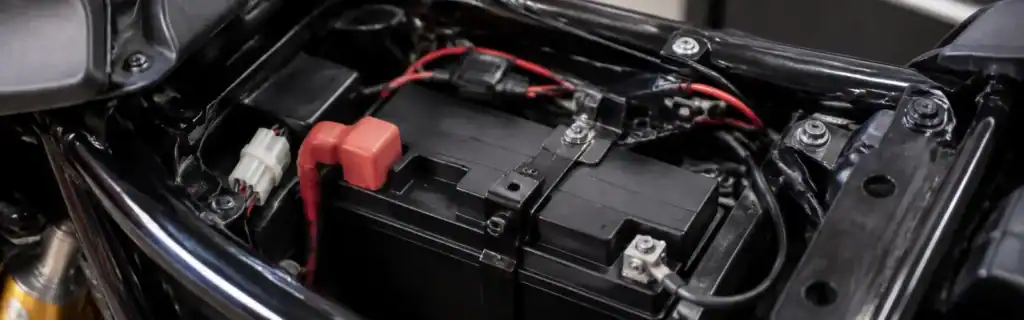
Traditional lead-acid, gel and AGM batteries can suffer from sulphation when stored for long periods with a low state of charge. Lead sulphate crystals form on the battery plates, potentially reducing both capacity and available starting power.
Lithium batteries, usually LiFePO4 batteries, should not be discharged too deeply either. In some lithium batteries, the built-in battery management system (BMS) switches the battery off when the voltage becomes too low. Excessive discharge may also damage the battery cells.
The three scenarios: which option is best?
1. Motorcycle stored in a garage with power: use a smart battery maintainer
Do you have access to a power socket near your motorcycle? A suitable smart battery charger and maintainer is usually the easiest solution.
- Connect the charger directly to the battery or use a permanent charging lead attached to the battery terminals.
- A modern smart charger automatically adjusts the charging process and switches to a maintenance programme once the battery is charged.
- Always check that the charger is suitable for your specific battery type.
The term trickle charger is often used, but a modern smart battery maintainer is preferable for long-term winter storage. Unlike a basic trickle charger that continuously supplies a small charging current, a smart charger adjusts its output according to the battery’s condition.
Take extra care with a lithium battery
Does your motorcycle have a lithium or LiFePO4 battery? Only use a charging programme specifically designed for that battery type.
Some chargers intended for lead-acid batteries have a desulphation or reconditioning programme that uses higher charging voltages. These programmes may be unsuitable for lithium batteries.
Always check the instructions provided by both the battery manufacturer and the charger manufacturer.
Charging through the 12V socket or CAN bus
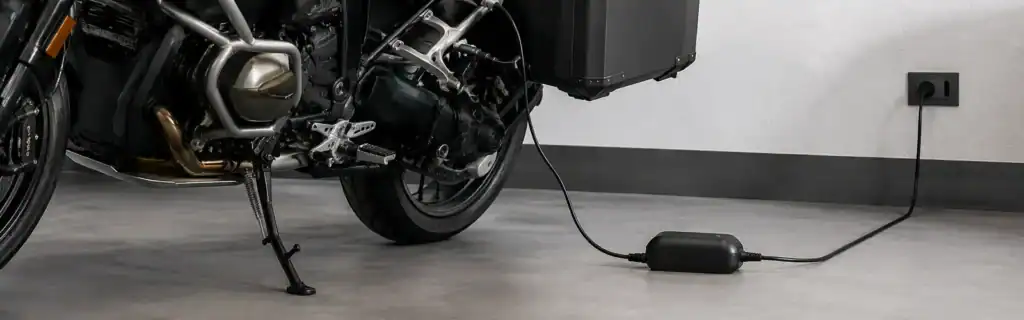
Some motorcycles allow the battery to be charged through the original 12V accessory socket. However, this does not work with every charger.
On motorcycles where the socket is electronically controlled by the onboard computer, it may be switched off shortly after the ignition is turned off. If you want to charge through this socket, check that both the motorcycle and the battery charger support this charging method.
2. Storage without power: disconnect the battery
If there is no power socket near your motorcycle, you can disconnect the battery to prevent parasitic drain from the motorcycle’s electronics.
- Always disconnect the negative terminal first.
- Check the battery’s state of charge occasionally during winter.
- Recharge it with a suitable battery charger when necessary.
Bear in mind that disconnecting the battery may cause certain settings to be lost. These could include the clock, trip meter data or personal settings stored in the onboard electronics.
An alarm system or GPS tracker may also stop working when the battery is disconnected.
3. Remove the battery from the motorcycle
Is the motorcycle stored outside for a long period, is the battery difficult to access or do you want to check and charge it easily during winter? In that case, you can remove the battery completely.
When removing the battery, disconnect the negative terminal first and then the positive terminal. When reinstalling it, follow the reverse order: positive first, followed by negative.
Store the battery in a dry, cool and well-ventilated location. Check its state of charge during winter and recharge it according to the manufacturer’s instructions.
A battery does not necessarily need to be stored somewhere warm inside your home. It is more important to keep it dry and prevent it from remaining at a low state of charge for an extended period.
Why occasionally idling the engine achieves very little
Starting the motorcycle every few weeks and leaving it to idle for ten minutes may sound like an easy way to maintain the battery. In practice, it offers very little benefit.
- The starter motor draws a relatively large amount of energy from the battery.
- A short period of idling may not fully replace the energy used during starting.
- The engine, oil and exhaust system may not reach their full operating temperature.
- As a result, moisture produced during warming may not evaporate completely.
If you do want to start the motorcycle during winter, it is better to take it for a proper ride. This allows the engine and exhaust system to reach their full operating temperature and gives the battery enough time to recharge.
Naturally, you should also take cold tyres, slippery roads and road salt into account.
Check accessories for parasitic drain
Have you installed aftermarket accessories? Check whether they actually switch off when the ignition is turned off.
Possible sources of parasitic drain include:
- USB chargers;
- sat-nav mounts;
- GPS trackers;
- heated accessories;
- additional lighting;
- alarm systems.
Even a small but continuous electrical drain can be enough to discharge a motorcycle battery considerably over several months.
Does your battery also lose charge unusually quickly during the riding season? It may be worth measuring the motorcycle’s parasitic current draw or asking a technician to check it.
How can you tell whether your motorcycle battery is still healthy?
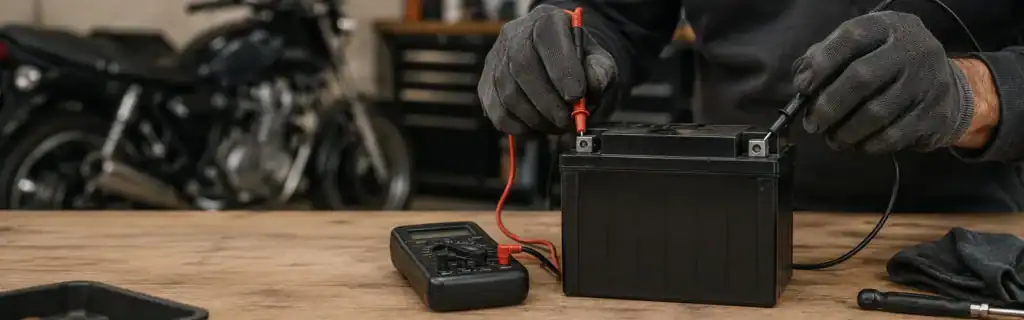
A battery may show a normal voltage after charging while still being unable to supply sufficient starting power.
Look out for warning signs such as:
- the starter motor turns noticeably more slowly;
- the dashboard dims or almost switches off while starting;
- the battery loses its charge again shortly after being recharged;
- the motorcycle becomes difficult to start again after only a short period of storage;
- the battery has already been fully discharged several times.
Are you unsure about the condition of the battery? A motorcycle workshop or battery specialist can perform a load test. This provides a much better indication of the battery’s actual starting capacity than a voltage measurement alone.
What is the best solution for your motorcycle?
For most motorcyclists, the choice is relatively straightforward:
- Garage with power: use a suitable smart battery charger and maintainer.
- Garage without power: disconnect the battery and check its state of charge during winter.
- Want to keep the battery easily accessible: remove it from the motorcycle and store it somewhere cool and dry.
- Lithium battery: only use a charging programme that is explicitly suitable for your battery.
Checklist: preparing your motorcycle battery for winter
- Battery type checked: lead-acid, AGM, gel or lithium/LiFePO4
- Battery terminals checked for dirt and corrosion
- Suitable smart battery maintainer connected if power is available
- Correct charging programme selected for the battery type
- For a lithium battery, checked that the charger is suitable
- No power available? Negative terminal disconnected or battery removed
- Alarm, tracker and other accessories checked for parasitic drain
- Battery’s state of charge checked during winter
- Motorcycle not left idling briefly just to recharge the battery
- Battery checked and, if necessary, recharged before the first spring ride
Starting the motorcycle again in spring
If the battery has survived winter in good condition, the motorcycle should start normally in spring.
Install or reconnect the battery correctly. Before setting off, check not only the battery but also the tyre pressures, chain, brakes, lights and fluid levels.
After that, only the most enjoyable question remains: where will your first motorcycle ride of the new season take you?